What is the difference between Hajj and Umrah? While both of these spiritual journeys are acts of deep devotion that involve the sacred state of Ihram, Tawaf around the Holy Kaaba, and Sa’i between Safa and Marwa, they hold entirely different rulings, weights, and rewards in Islamic jurisprudence (Fiqh).
Understanding the distinct boundaries of these two types of pilgrimage to Makkah is essential. One represents an absolute cornerstone of our faith, while the other is a highly recommended act of devotion that can be performed year-round. In this comprehensive guide, we will break down the 10 major differences between Hajj and Umrah—covering everything from their spiritual status as Fard (obligation) versus Sunnah, to their specific timings in the Islamic lunar calendar, geographic locations, and ritual complexities.
What is the difference between Hajj and Umrah?
Hajj and Umrah are two great types of worship in Islam. They are similar in several points, however, they have major differences.
Here are the 10 core differences between the Major Pilgrimage (Hajj) and the Minor Pilgrimage (Umrah) to be discussed throughout the article:
| # | Feature | Hajj (The Major Pilgrimage) | Umrah (The Minor Pilgrimage) |
| 1 | Pillar of Islam | It is one of the Five Pillars of Islam; fundamental to faith. | It is a highly virtuous act, but not a pillar of Islam. |
| 2 | Islamic Ruling | Fard (Obligatory) for every mature, able, and financially stable Muslim. | Highly recommended Sunnah |
| 3 | Frequency | Required only once in a lifetime to fulfill the obligation. | Can be performed numerous times throughout your life. |
| 4 | Location | Extends outside Makkah to sacred sites (Arafat, Muzdalifah, Mina). | Done exclusively within the boundaries of Al-Masjid Al-Haram in Makkah. |
| 5 | Timing | Restricted to specific days in the Islamic month of Dhul-Hijjah. | Can be performed at any time or hour of the year. |
| 6 | Duration | Requires an intense, spiritual commitment over several days. | Highly accessible; can be completed in just a few hours. |
| 7 | Rituals & Pillars | Includes Umrah rituals plus Arafat, Muzdalifah overnight, and Jamarat (stoning). | Consists only of Ihram, Tawaf, Sa’i, and Halq/Taqseer (hair cutting). |
| 8 | Crowd Size | A massive, universal gathering hosting millions of Muslims simultaneously. | A continuous, steady stream of daily pilgrims year-round. |
| 9 | Spiritual Reward | An accepted Hajj yields no less a reward than Paradise (Jannah). | Serves as an expiation (wiping away) of sins committed between Umrahs. |
| 10 | Types | Offers 3 distinct variations: Ifrad, Qiraan, and Tamatu’. | Included in only two types of hajj: Ifrad and Tamatu’. |
1. Hajj is One of The Pillars of Islam While Umrah is not.
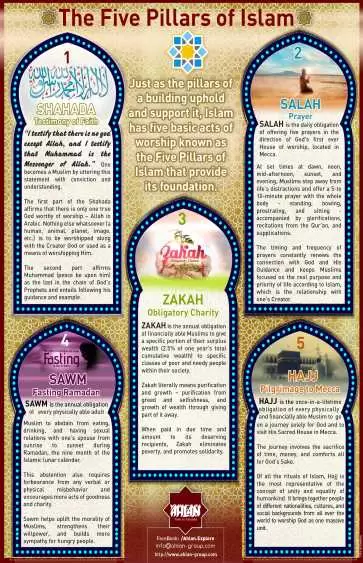
Prophet Muhammad (PBUH) said that Islam is based on five pillars: Shahadah, performing Salat (prayer), giving Zakat (charity), fasting Ramadan, and Hajj (for those who have the ability).
It is worth mentioning that Hajj is among the five basic pillars of Islam, while Umrah is not.
2. Hajj is Fard However Umrah is Sunnah.
As we previously mentioned, Hajj is among the five basic pillars of Islam, thus, it is an obligation for every mature, able, conscious muslim.
On the other hand, Umrah is a kind of Sunnah, that if done, God grants you reward. However, if you don’t, you don’t hold any sin.
It is worth mentioning that both Hajj and Umrah are worth great reward from God in this worldly life and the hereafter.
3. Hajj is enough once a lifetime while Umrah could be numerous.
God (SWT) has obliged Hajj for able Muslims only once a lifetime. However, Umrah -as a Sunnah- could be done whenever you wish.
That doesn’t mean that a Muslim couldn’t perform Hajj more than once. However, doing it once is enough for an able Muslim to fulfill God’s obligation.
4. Hajj is in Makkah and its surroundings While Umrah is done in Makkah only.
Umrah is done in Al-Masjid Al-Haram (The holy Mosque) in Makkah. However, Hajj involves other surrounding places such as Arafat, Muzdalifah, and Minah.
This makes Hajj greater and more comprehensive than Umrah.
To know more about where Muslims go during Hajj, follow our previous articles.
5. Hajj should be done in a specific Hijri (Lunar) Month while Umrah is done all the year.
It is worth mentioning that Hajj should be done at a specific time every year. It starts in the Hijri month Dhul-Hijjah and each pillar is related to a specific time.
For example, staying in Arafat should be done on the 9th of Dhul-Hijjah and moving on to Muzdalifah should be before the sunrise of the 10th day of Dhul-Hijjah.
On the other hand, Umrah is done at any time during the year and at any hour. Thus, you always see Muslims performing Umrah whenever you watch the live stream of The Holy Mosque.
6. Hajj requires several days while Umrah could be completed in just a few hours.
Due to the detailed, timed, and comprehensive nature of Hajj, it requires staying several days in Makkah and its surroundings to have your Hajj completed.
In case of Umrah, you only need a few hours to complete your Umrah as you don’t have to stay anywhere. However, some Muslims may stay after their Umrah to perform their prayers in The Holy Masjid which is not a part of Umrah.
If you need to know more about Umrah, follow our article: How To Perform Umrah?
7. Hajj has many more pillars than Umrah.
Hajj is a great Umrah. This means that Hajj includes the deeds of Umrah and more.
For example, Umrah pillars are: Ihram, Tawaf, Sa’i, and Halq/Taqseer. While Hajj includes -in addition to what’s previously mentioned: staying in Arafat, Muzdalifah, Minah, and throwing Jamarat.
For more information about Hajj pillars, read that article.
8. Hajj is a greater gathering of Muslims than Umrah.
Hajj and Umrah are considered great gatherings of Muslims from different ethnicities, nationalities, and backgrounds all over the world.
There are millions of people performing Umrah everyday. However, ten million Muslims and more are performing Hajj in its season.
This makes Hajj a more universal and greater gathering of Muslims than Umrah.
9. Hajj is more rewarding than Umrah.
Hajj is Fard (obligation), that’s why its reward is far greater than that of Umrah.
Prophet Muhammad (PBUH) said:
“An ‘umra is an expiation for sins committed between it and the next, but a hajj which is accepted will receive no less a reward than paradise.”
(Mishkat al-Masabih 2508)
He also said: “Whoever performs Hajj (pilgrimage) and does not have sexual relations (with his wife), nor commits sin, nor disputes unjustly (during Hajj), then he returns from Hajj as pure and free from sins as on the day on which his mother gave birth to him.”
To read about the benefits of Umrah, read that article.
10. Types Of Hajj Vs Types Of Umrah
There are 3 types of Hajj: Ifrad, Qiraan, and Tamatu’. However, Umrah is included in only 2 types of these hajj types: Ifrad and Tamatu’.
To learn more about the 3 types of Hajj, read that article.
Conclusion
To conclude, while both Hajj and Umrah offer a powerful path to spiritual purification and a clean slate free from sins, they serve different roles in a believer’s life. Umrah is a brief, beautiful act of love and Sunnah that can be completed in just a few hours at any time of the year. In contrast, Hajj is a rigorous, multi-day, and deeply transformative universal gathering that demands physical strength, financial capability, and strict adherence to specific dates in the holy month of Dhul-Hijjah.
Subscribe to the Explore Islam newsletter today to get authentic, reliable Islamic knowledge delivered straight to your inbox and keep your heart connected to the Ummah.