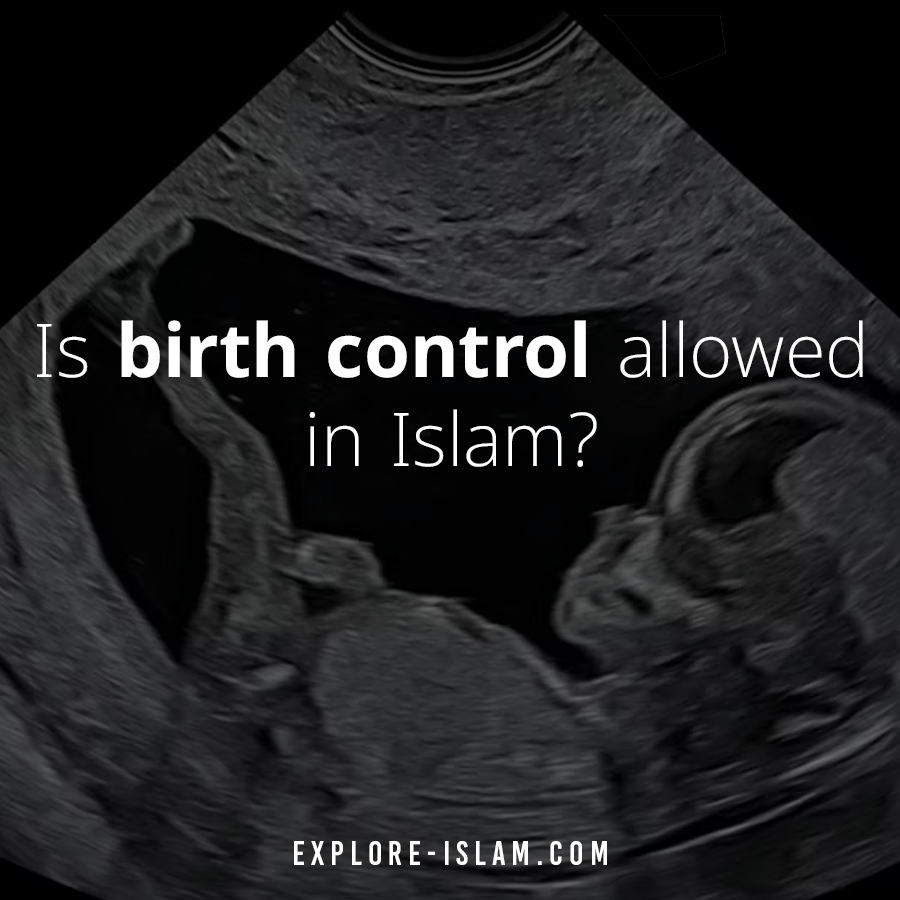
Does Islam believe in abortion? The answer to this question is complex and often debated among Muslim scholars.
While the Islamic teachings emphasize the sanctity of human life, yet there are specific circumstances where abortion may be considered permissible under strict conditions.
Factors such as the stage of pregnancy, the mother’s health, and fetal viability play a crucial role in Islamic rulings regarding abortion.
In this article, we will discuss the Islamic rulings on abortion, based on Quranic teachings, Prophetic Hadiths, and opinions of Muslim scholars, to provide a clear answer to whether abortion is allowed in Islam or not.
Does Islam Believe in Abortion?
In Islam, human life is considered sacred, and preserving life is one of the five fundamental principles of the Islamic doctrine (maqasid al-shariah).
Although Islam generally forbids abortion, there are minor exceptions to this general rule. In other words, Muslim scholars’ opinion on abortion is based on the timing and reason for abortion. Now, let us discuss these exceptions where abortion may be permitted in Islam.
Does Islam Allow Abortion Before Ensoulment (Before 120 Days)?
As we have previously mentioned, abortion is impermissible in Islam, as it is considered killing a soul without right, which is a major sin. However, there are a few exceptions to this rule.
According to some Muslim scholars, abortion before the soul is breathed into the fetus (before 120 days) is permissible under certain conditions, such as:
– Severe fetal abnormalities
– Risk to the mother’s life
– Rape or incest (Some scholars permit abortion in early pregnancy for victims of sexual violence, though this remains debated among scholars).
This opinion relies on the evidence from the Hadith of Prophet Muhammad (Peace and Blessings be Upon Him), stating that the fetus is not considered a full human being until 120 days/ 4 months of pregnancy, when the soul is breathed into the embryo.
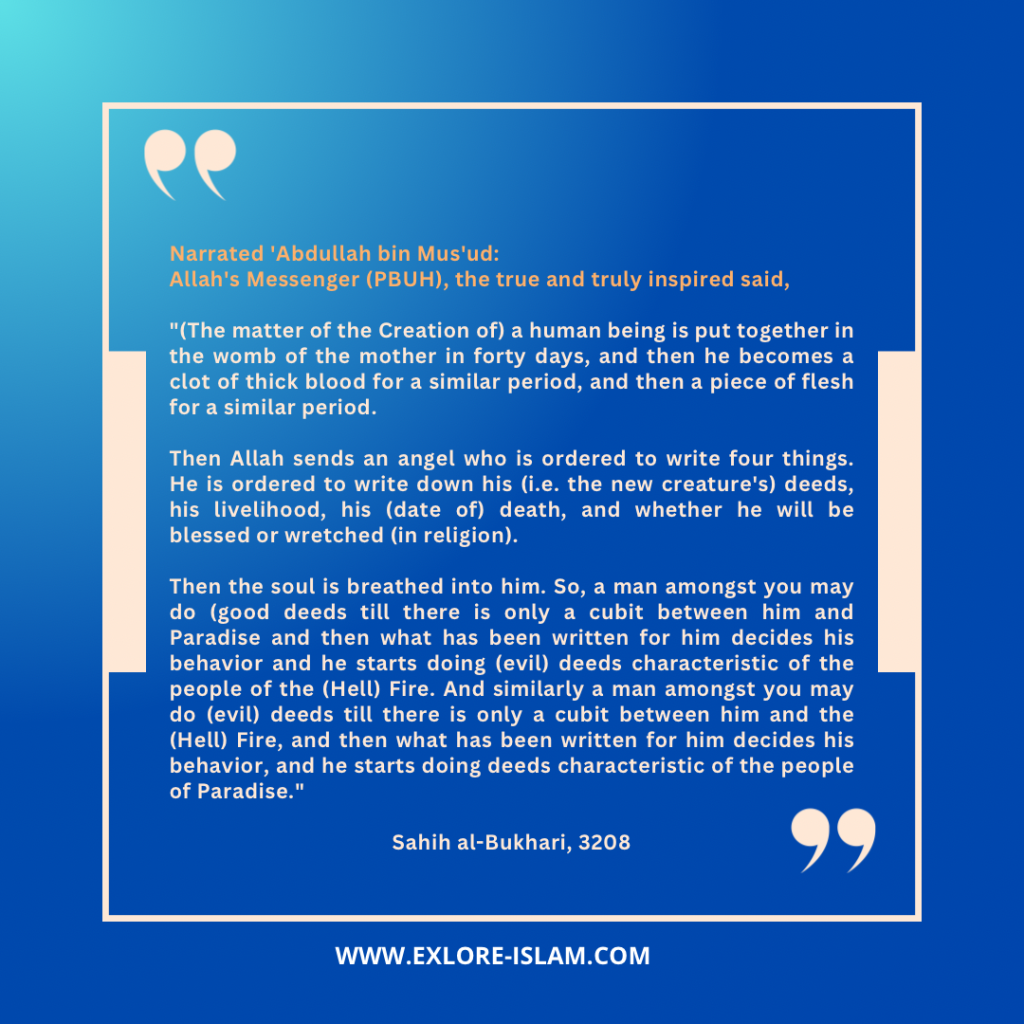
Narrated `Abdullah bin Mus’ud:
Allah’s Messenger (PBUH), the true and truly inspired said,
“(The matter of the Creation of) a human being is put together in the womb of the mother in forty days, and then he becomes a clot of thick blood for a similar period, and then a piece of flesh for a similar period. Then Allah sends an angel who is ordered to write four things. He is ordered to write down his (i.e., the new creature’s) deeds, his livelihood, his (date of) death, and whether he will be blessed or wretched (in religion).
Then the soul is breathed into him. So, a man amongst you may do (good deeds till there is only a cubit between him and Paradise, and then what has been written for him decides his behavior and he starts doing (evil) deeds characteristic of the people of the (Hell) Fire. And similarly, a man amongst you may do (evil) deeds till there is only a cubit between him and the (Hell) Fire, and then what has been written for him decides his behavior, and he starts doing deeds characteristic of the people of Paradise.”
However, even in these cases, abortion should only be considered after consulting more than one well-trusted, knowledgeable, religious, Muslim doctor.
Does Islam Allow Abortion After Ensoulment (After 120 Days)?
After the soul enters the fetus (120 days of pregnancy), Muslim scholars agree that abortion is haram (forbidden) unless the mother’s life is in immediate danger, or when pregnancy poses a serious threat to the mother’s life.
The reason for that is that, in Islam, the preservation of the mother’s life is prioritized over preserving the unstable life of the fetus. (However, the necessity for terminating the pregnancy should be evaluated by knowledgeable, trusted Muslim doctors.)
At this stage, the fetus is considered a living being with rights, and terminating the pregnancy is viewed similarly to murder and hence requires sincere repentance.
Allah said in Surah Al-Isra, verse 33:
“And do not kill the soul which Allah has forbidden, except by right. And whoever is killed unjustly – We have given his heir authority, but let him not exceed limits in [the matter of] taking life. Indeed, he has been supported [by the law]”.
(Sahih International)
Things Muslims Should Consider Before making the Abortion Decision
Even when abortion is permitted under the aforementioned conditions, Muslims should follow the following steps before deciding to terminate the pregnancy:
Consulting Muslim Scholars
Seeking guidance from qualified Muslim scholars is necessary before taking the decision to terminate pregnancy.
Seeking Medical Advice:
Ensuring decisions are made with proper medical consultation of trustworthy Muslim physicians is crucial before undergoing abortion.
Is abortion a sin in Islam?
This depends on the stage of pregnancy and the reason for performing this procedure. Before ensoulment, abortion may be allowed in case of severe fetal anomalies or when pregnancy endangers the mother’s life. While after ensoulment (120 days of pregnancy), abortion is considered a major sin unless the mother’s life is at major risk.
However, Muslims are encouraged to seek individualized religious and medical counseling before making such a grave decision.
Can a Muslim Woman Abort a Pregnancy Due to Financial Difficulties?
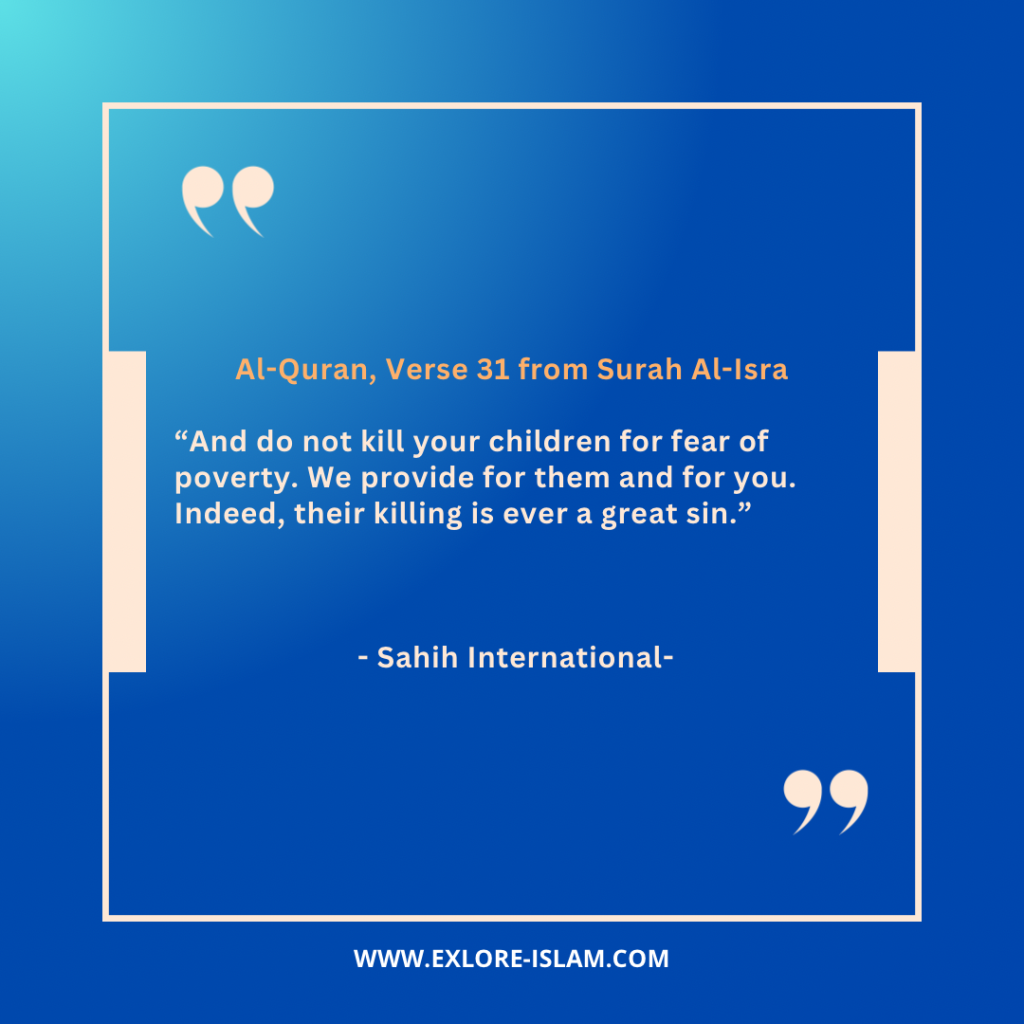
Muslim scholars do not permit abortion for financial reasons, as Islam encourages believers to have trust in Allah’s provision and believe in Allah as the provider for all human beings.
Allah Subhanahu Wa Ta’ala says in the Quran, Surah Al-Israa, Verse 31:
What if the pregnancy is from rape?
Some Muslim scholars allow early abortion (less than 120 days) in cases of rape, while others prohibit it. Therefore, in such cases, a qualified Muslim scholar should be consulted.
The Opinion of the Islamic Fiqh Assembly of the Muslim World League On abortion
The Islamic Fiqh Assembly of the Muslim World League (based in Mecca) decided that:
“If the fetus has reached 120 days, it is impermissible to perform an abortion even if it is medically diagnosed with congenital defects. However, if a committee of specialized physicians decided that continuing the pregnancy carries a risk to the life of the mother, then it is permissible to conduct an abortion, whether or not the fetus was deformed, to undertake the lesser of the two harms”.
Conclusion
Islam values the sanctity of life, and while abortion is generally forbidden in Islam, there are minor exceptions to this rule.
Therefore, the answer to the question, Does Islam believe in abortion, depends on individual circumstances, including the timing of abortion and the health condition of the mother and her fetus as specified by a trusted Muslim doctor.
In all cases, consulting a trusted Muslim scholar or imam is highly recommended before taking such a grave decision that has a great impact on the life of the mother and her fetus.
Explore More!
If you have further questions about Islam, feel free to contact the ExploreIslam team to get clear, comprehensive answers to all your questions.