
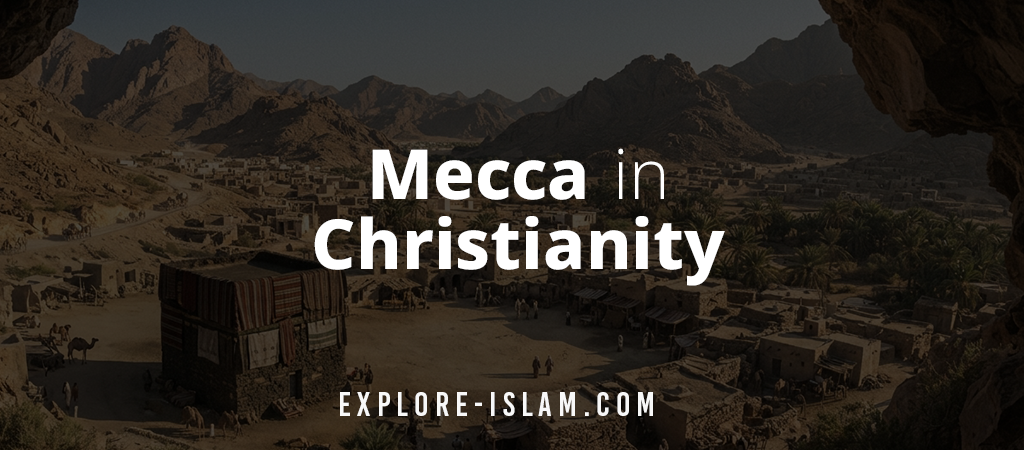
Mecca is not mentioned in the Bible. The city that houses the Kaaba, Islam’s most sacred site, does not appear as a proper noun anywhere in the Old or New Testament.
What does appear, and what has fueled centuries of comparative discussion between Christian and Muslim scholars, are passages describing Abraham’s son Ishmael being sent into the Arabian wilderness — a narrative thread Muslims connect directly to Mecca’s founding.
Does the Bible Contain a Direct Reference to Mecca by Name?
No, the Bible contains no direct reference to Mecca by name. Anyone searching biblical text for the word “Mecca” will not find it. The city’s name, in its Arabic form Makkah, belongs to a linguistic and geographic tradition that developed independently of the Hebrew scriptures compiled centuries before Islam’s advent.
This absence is often raised by skeptics as evidence against Mecca’s ancient religious significance.
That reasoning misunderstands how sacred geography works across scripture. The Bible also never names Medina, Karbala, or dozens of other sites that carry deep meaning in later religious history — simply because those texts were written for their own time, audience, and revelation.
Absence of a later place-name in an earlier text is not evidence against that place’s antiquity or sanctity. It only reflects the boundaries of what a given scripture set out to record.
What matters more to comparative theology is not whether the word “Mecca” appears, but whether the events and figures tied to Mecca’s founding are present in the biblical narrative. On that question, the Bible has considerably more to say.
Genesis Describes Ishmael’s Exile Into Arabian Wilderness
The clearest biblical connection to the region surrounding Mecca comes through the story of Hagar and Ishmael. According to Genesis, Sarah asked Abraham to send away Hagar and her son after Isaac’s birth, and Abraham complied, sending them into the wilderness of Beersheba. The text later specifies that Ishmael “dwelt in the wilderness of Paran”
Paran’s exact location has been debated among biblical geographers for centuries, with some placing it in the Sinai Peninsula and others extending it toward the northern Hejaz — the region where Mecca sits.
Islamic tradition holds firmly that Hagar and Ishmail were led by divine command to the valley of Mecca itself, where the well of Zamzam later sprang forth to sustain them.
This is one of the few points where the biblical account and the Quranic account run parallel rather than contradictory. Both traditions agree that Ishmael was sent away from his father’s household into a desert region.
The disagreement is not over whether this happened, but over where exactly it happened and what significance it carries afterward.
Islam and Chritianity Trace Ishmael’s Descendants to Arabia
Genesis goes further than simply placing Ishmael in the wilderness. It also describes his descendants settling across a wide arc of territory.
The text states that Ishmael’s sons “settled from Havilah to Shur, near the border of Egypt, in the direction of Ashur”
a description many historians read as encompassing the northern and central Arabian Peninsula.
Islamic scholarship holds that Ismail settled specifically in Mecca, married into the Arab tribe of Jurhum, and became the ancestral father of the Arabs of the Hejaz — a lineage trace directly to Prophet Muhammad (PBUH) himself.
Readers exploring this genealogy in more depth may find it useful to review how the Quran addresses the broader narrative of the prophets shared across the Abrahamic traditions, since the Ishmael account is only one thread in a much larger scriptural continuity that the Quran affirms and, in places, corrects.
The Quran Identifies Mecca as the Site of the First House of Worship
While the Bible gestures toward the region, the Quran speaks about Mecca with direct, unambiguous clarity. Allah describes the Kaaba as the first structure ever established for the worship of one God:
إِنَّ أَوَّلَ بَيْتٍ وُضِعَ لِلنَّاسِ لَلَّذِي بِبَكَّةَ مُبَارَكًا وَهُدًى لِّلْعَالَمِينَ
“Indeed, the first House [of worship] established for mankind was that at Makkah — blessed and a guidance for the worlds.”
This verse is central to Islamic belief about Mecca’s origin. It does not describe the Kaaba as one sacred site among many, but as the foundational one — predating even the later sanctuaries described in the Hebrew Bible. The Quran also names Ibrahim and Ismail directly as the ones who raised its foundations:
وَإِذْ يَرْفَعُ إِبْرَاهِيمُ الْقَوَاعِدَ مِنَ الْبَيْتِ وَإِسْمَاعِيلُ
“And [mention] when Ibrahim was raising the foundations of the House and [with him] Ismail.”
These two verses together form the theological backbone of Mecca’s sanctity in Islam. Mecca is not sacred because a prophet passed through it. It is sacred because it houses the very structure that same prophet was commanded to build. For a deeper look at how the Quran positions itself relative to earlier revelation, see how Islam relates to the Old Testament.
Some Christian Scholars Have Proposed a Biblical Link to Mecca’s Location
A number of Christian and secular historians have engaged seriously with the question of whether Old Testament geography extends into the Hejaz. The wilderness of Paran, the “border of Egypt,” and references to Ishmaelite trading caravans in Genesis 37 have all been cited as evidence that the biblical authors were, at minimum, aware of Arab tribal presence deep into the peninsula.
This is not a settled academic consensus, and Explore Islam researchers are careful not to overstate what remains genuinely contested among historians.
What can be said with confidence is that the biblical text does not close the door on an Arabian setting for Ishmael’s descendants — and in several places, it points toward one.
Why Does Not the Absence of Mecca in the Bible Undermine Its Islamic Significance?
A curious reader encountering this topic for the first time might reasonably ask: if Mecca is truly ancient and truly sacred, why would the Bible — written by prophets whom Islam itself honors — say nothing explicit about it?
The Hebrew Bible centers overwhelmingly on the line of Isaac and Jacob, tracing Israelite history, law, and prophecy through that specific lineage.
Ishmael’s departure into the wilderness marks his narrative exit from that particular text — not because his story ended there, but because the Bible’s authors were not writing his continuation.
Islam does not treat this as a gap needing to be filled by speculation. It treats the Quran as the scripture that completes the account the earlier books left open, naming Ismail’s fate, his role in building the Kaaba, and his place among the prophets with a specificity the Bible never attempted.
This is a natural extension of how Islam approaches all prior revelation. Muslims affirm the Torah and Gospel as authentic divine revelation in their original form, while holding that the Quran was sent to confirm, clarify, and in places correct what had been altered or lost over centuries of transmission.
Readers interested in this framework may want to review how Islam views the Bible more broadly, or examine why Muslims believe in one God as the foundation of salvation.
Continue Exploring These Questions With Explore Islam
Curiosity about where faiths converge and diverge is exactly what Explore Islam was built to welcome.
If this raised more questions than it answered, that’s a good sign — keep going.
Browse more comparative faith topics at Explore Islam Articles & Resources.
Have a specific question about Mecca, Abraham, or anything else? Reach out directly — all questions welcome.
Start wherever you are. We’ll meet you there.
Summary
Mecca’s absence from the Bible reflects the scope of Hebrew scripture, not the age or sanctity of the city itself. Genesis places Ishmael’s descendants in Arabian wilderness regions, a detail the Quran later confirms and completes with specific names and events.
The Quran and authenticated Hadith establish Mecca as the site of the first house of worship, built by Ibrahim and Ismail for all humanity. This shared Abrahamic root offers a starting point for honest dialogue between both faith traditions.
Frequently Asked Questions
Is Mecca mentioned anywhere in the Bible?
No, Mecca is not named directly in the Bible. The Old Testament describes Ishmael’s descendants settling in Arabian wilderness regions, including “Paran,” which some scholars connect geographically to the Hejaz, but the city name itself never appears in Hebrew or Christian scripture.
Does the Bible confirm that Ishmael went to Arabia?
The Bible states that Ishmael dwelt in the wilderness of Paran (Genesis 21:21) after being sent away with his mother Hagar. Islamic tradition identifies this journey as leading specifically to Mecca, where Ismail later helped his father build the Kaaba.
Why do Muslims believe Mecca is the first house of worship?
Muslims base this belief on Quran 3:96, which states the first house established for mankind was at Mecca. This is reinforced by authentic Hadith in which Prophet Muhammad (PBUH) confirmed the city’s sanctity dates to the creation of the heavens and earth.
Why doesn’t the Bible mention the Kaaba directly?
The Hebrew Bible focuses primarily on the lineage of Isaac and Jacob, so Ishmael’s story exits the narrative after Genesis 25. Islam holds that the Quran completes this account, describing Ismail’s life in Mecca and his role in constructing the Kaaba with specific detail absent from earlier scripture.