Eid prayers are one of the most important and spiritually uplifting events in Islam. In just a few days, Muslims worldwide will gather in mosques, streets, and open squares to perform Eid prayers, filling the air with the chant of “Allahu Akbar” (Allah is the Greatest) in celebration of the blessed occasion.
This guide to Eid prayers explains how to perform them correctly, the wisdom behind this unique act of worship, and the significance of congregational prayers in Islam. Whether you are a practicing Muslim or curious to learn about Islamic traditions, this guide provides clear insights into one of the most cherished rituals of Eid.
What are the two Eid prayers?
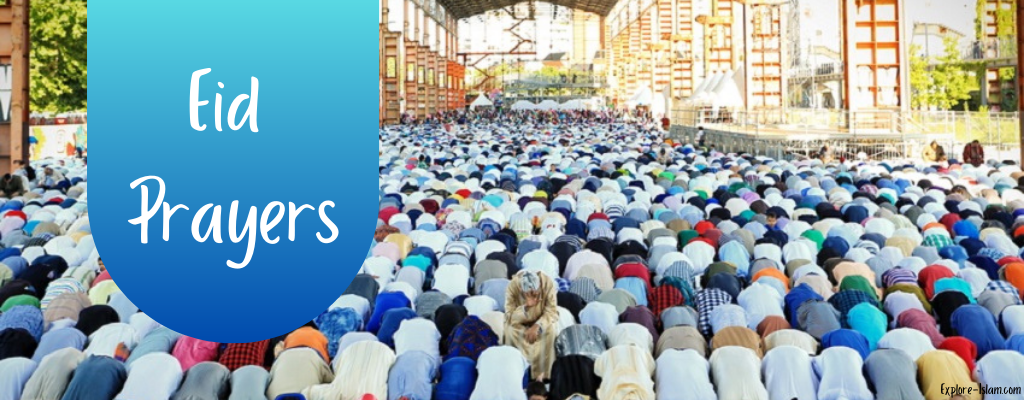
Muslims pray on the streets Eid prayers on Eid-ul-Fitr (the day of the breaking of the fast) and on Eid-ul-Adha (the day of sacrifice), in open areas to perform their Islamic ritual, meet together to congratulate one another and rejoice the bounties of their Lord.
Narrated Aisha RAA, “The Messenger of Allah PBUH would say the Takbir (Allah is The Most Great) seven times in the first rak’ah and five times in the second rak’ah on the day of the breaking of the fast and on the day of sacrifice (on the occasion of both the Eid prayers, the two days of festivities)”. [Sunan Abi Dawud]
Read more: Benefits of Eid in Islam
What is the importance of Eid prayer?
Muslims are rejoicing at what Allah has bestowed upon them of His bounty (rewards and forgiveness), and that He has guided and helped them to perform ordained ‘Ibadat (worships).
As it’s known, fasting is hard, so Allah gives His believers Eid-ul-Fitr (a feast after the month of Ramadan). Also, Hajj (pilgrimage) is hard, so it is followed by Eid-ul-Adha. Thus, every hard act of worship is followed by ease, feasting and celebrations, Eid (days of festivity).
Read also: How to celebrate Eid?
Why do Muslims pray Eid in the streets?
Muslims perform Eid prayers in the streets and large open spaces to follow the guidance of the Quran and the teachings of the Prophet Muhammad (peace be upon him). Gathering in large numbers allows the community to perform the prayer together, strengthening unity, brotherhood, and the collective spirit of worship.Praying in an open congregation also emphasizes rejoicing in Allah’s blessings, celebrating the completion of Ramadan, for Eid al-Fitr prayer, and expressing gratitude for His mercy and forgiveness. The communal setting makes Eid prayers a uniquely visible and joyous manifestation of faith, shared by Muslims of all ages and backgrounds.
How to prepare for Salat Al-Eid?
A Muslim performs Ghusl (major purification) before prayers, eats an odd number of dates, dresses up and wears festive clothes in happiness and gratitude to Allah.
Also, exchanges greetings and well-wishes with family members and friends by saying Taqabbalallahu Minna wa Minkum – May Allah accept (all worship) from us and from you.
How many rak’at in Eid prayer?
Eid prayer is two Rak’at (units of prayer) done in a special manner in open air areas followed by the Khutba (preaching), following the Sunnah of the Messenger PBUH.
How do you pray Eid prayer?
Eid prayer time starts 15 minutes after sunrise and lasts until 10 to 15 minutes before Dhuhr (midday).
Muslims in their usual prayer start their Salaht with one Takbirah/ Takbirat-ul-ihram (to stand facing the Ka’bah with hands close to ears saying Allahu-Akbar, which means Allah is the Greatest). In Eid prayer, they start with Takbirat-ul-ihram followed by seven Takbirat in the first Rak’ah and five Takbirat in the second Rak’ah. After Salaht then comes the Khutba (preaching).
Abu said Al-khudri narrated: “The Prophet PBUH used to proceed to the Musalla (out of Masjid/ open area) on the days of Eid-ul-Fitr and Eid-ul-Adha; the first thing to begin with was the prayer and after that he would stand in front of the people and the people would keep sitting in their rows. Then he would preach to them, advise them and give them orders, (i.e. Khutba).” [Sahih al-Bukhari]
It is Sunnah going to the Musalla from one way and returning from another, following the example of Prophet Muhammad (PBUH). Abu Hurairah narrated that when the Prophet PBUH went out to Eid (prayers), he would return via another route than the first one he took. [Sunan Ibn Majah]
Eid prayer du’aa
Takbir (saying Allahu-Akbar) is a confirmed Eid Sunnah of the Messenger PBUH.
It is prescribed for the Muslims to recite Takbeer (“Allaahu akbar”), Tasbeeh (“Subhaan Allaah”), Tahleel (“Laa ilaaha ill-Allaah”) and Tahmeed (“al-hamdu Lillaah”).
Imam al-Shafi’i RAA said:
If he adds to that and says: “Allahu akbaru kabira wa alhamdu Lillahi kathira wa subhan Allahi bukratan wa asila, Allahu akbar wa la na‘budu illa Allah mukhlisina lahu al-dina wa law kariha al-kaafirun, la ilaha illa-Allah wahdahu, sadaqa wa‘dah wa nasara ‘abdah wa hazama al-ahzaba wahdah, la ilaha illa-Allah wa Allahu akbar (Allah is most Great, much praise be to Allah and glory be to Allah at the beginning and end of the day. Allah is most Great and we worship none but Allah, and we make our worship purely for Him (Alone) however much the disbelievers may hate that. There is no god but Allah Alone; He fulfilled His promise and granted victory to His slave and defeated the Confederates Alone. There is no God but Allah and Allah is most Great),” then he has done well. (Al-Umm, 1/241)
It should be done on the night before and on the morning of Eid, until the end of the khutbah on the day of Eid ul-Fitr and during the first ten days of Dhu’l-Hijjah until the end of the days of Tashreeq on the occasion of Eid ul-Adha because Allah SWT says concerning Eid ul-Fitr in Quran (interpretation of the meaning): “(He wants that you) must complete the same number (of days), and that you must magnify Allaah [i.e. to say Takbeer (Allaahu Akbar: Allaah is the Most Great)] for having guided you” [2:185]
Read: What is Eid
What’s the significance of chanting Takbir over and over again?
Saying Allahu Akbar is a declaration to the Greatness of Allah and that Allah is greater than our desires so, we sacrifice our bodily needs in the month of Ramadan. Also, Allah is greater than our money that we pay, and effort that we do to perform Hajj (pilgrimage), we offer them in submission and obedience. Muslims show in everything they do that Allahu Akbar.
Allahu Akbar when we obey Him. Allahu Akbar during our rejoicing. Allahu Akbar in our prayers.
Is Eid prayer compulsory for women?
The Prophet Muhammad PBUH commanded women to participate in Eid prayer, even menstruating women should attend and do Du’aa but not pray as a confirmed recommendation (get rewarded for doing but no punishment for foregoing).
Narrated Um Atiya RAA: “We used to be ordered to come out on the Day of Eid and even bring out the young girls from their houses and menstruating women so that they might stand behind the men and say Takbir along with them and invoke Allah along with them and hope for the blessings of that day and for purification from sins.” [Sahih al-Bukhari]
Even women who don’t have a dress or veil, he ordered them to borrow one from their friends to be able to participate.
Umm Atiyyah narrated: “Allah’s Messenger would order the young girls, the mature women, the secluded and the menstruating to go out for the two Eid prayers. As for the menstruating women, they were to stay away from the Musalla and participate in the Muslims supplications.” One of them said: ‘O Messenger of Allah! What if she does not have a Jilbab? He said: ‘Then let her sister lend her a Jilbab.’“ [Jami at-Tirmidhi]
Can you do Eid prayer at home?
Yes, according to Muslim scholars Eid prayer may be done at home alone or even better in Jama’ah (Congregation) but certainly doing it in the recommended way is better and more rewarding.
It is the same as the prayer for Eid at the Masjid but there will be no khutbah (Eid sermon).
Conclusion
To conclude, Eid prayer in the streets is a confirmed Sunnah, not a power parade. It is just a performance of an Islamic ritual and a sign of obedience and gratitude to Allah.
While performing Eid prayers in the mosque or open ground is highly recommended, it is also permissible to pray at home, especially for women or those unable to attend the congregation. Understanding the importance of Eid prayer, including the correct number of rakats, the recommended dua (supplications), and what to say during the prayer, ensures it is performed properly.
Both Eid prayers—Eid al-Fitr and Eid al-Adha prayers—follow a similar structure and provide a special chance to connect with Allah, reflect on His blessings, and celebrate this joyous occasion in unity with the Muslim community.
Muslims meet together to congratulate one another for the forgiveness and bounties of Allah and rejoice for the wellness on Eid.
Why not share with Muslims in your city the next Eid and tell us of your experience?