The question of gender equality in Islam is often debated, with perspectives ranging from traditional interpretations to modern views. While classical teachings assign complementary roles, contemporary scholars argue that Islamic principles can align more with universal notions of equity.
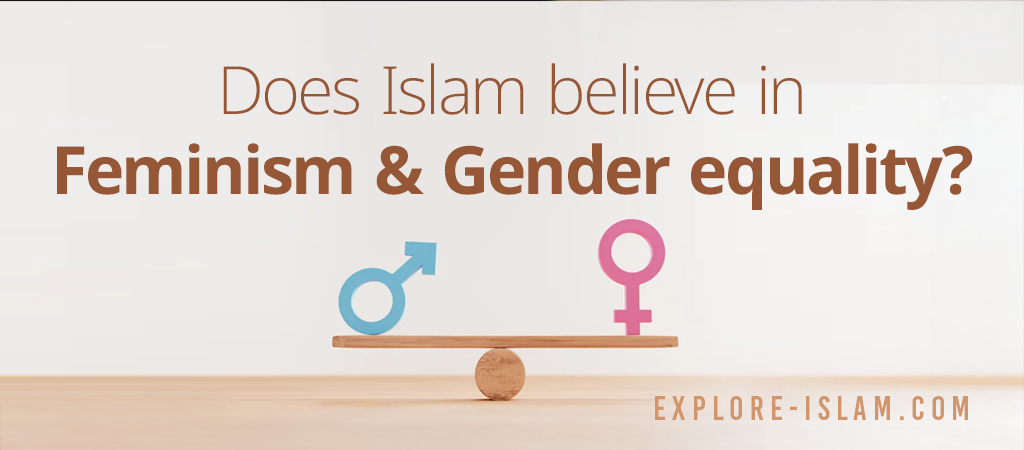
This article explores the issue of gender equality in Islam through Quranic verses and Prophetic Sunnah (Hadith). It examines the meanings of gender equality and gender equity and how they are different from each other. Then, it clarifies how Islam affirms equal spiritual worth but acknowledges functional differences and roles between men and women.
What Is Gender Equality?
A concise definition of gender equality is ensuring the same treatment for all. According to this definition, if a father has two 2-kg bags of groceries, he should give one to his son and one to his daughter to carry. This is equal, but not fair. The reason is that a boy is, by nature, physically stronger than a girl who usually gets tired more easily.
How Is Gender Equality Different From Gender Equity?
Another key term is gender equity, which refers to fair treatment based on individual needs. Using the same metaphor, the father might wisely ask his son to help him carry groceries while his daughter assists her mother in preparing lunch—to ensure tasks align with each child’s abilities and the family’s collective needs. This complementary (not unequal) distribution of duties exemplifies how equity can achieve fairness for both males and females.
Does Islam Teach Gender Equality or Gender Equity?
Islam affirms spiritual equality between men and women but interprets social and legal roles through complementarity—where rights and responsibilities may differ, yet share the ultimate goal of justice. This raises a critical question: How does Islam balance equality in dignity with differentiation in duties? Below is a simple analysis based on Islamic teachings:
Spiritual Equality: Equal In Worth And Accountability:
The Quran explicitly states that men and women are equal before Allah. They are equal in dignity, spiritual potential, and moral responsibility. Let’s see below how both genders are equally accountable before their Creator:
In obligations:
The Quran establishes equal spiritual obligations for men and women in matters of faith and worship.
In this regard, Allah says:
“Surely ˹for˺ Muslim men and women, believing men and women, devout men and women, truthful men and women, patient men and women, humble men and women, charitable men and women, fasting men and women, men and women who guard their chastity, and men and women who remember Allah often—for ˹all of˺ them Allah has prepared forgiveness and a great reward.”
This verse highlights identical spiritual obligations for both men and women, including faith, devotion, truthfulness, patience, humility, charity, and moral integrity. These duties are equally binding on both genders, affirming their equal accountability before Allah.
Also in the Sunnah, Prophet Muhammad (peace be upon him) said:
“… Women are the counterparts of men.”
In this hadith, Prophet Muhammad (peace be upon him) emphasized that women share the same humanity, rights, and spiritual status as men.
In Rewards:
The Quran explicitly affirms equal spiritual rewards for men and women in multiple verses, emphasizing that divine recompense is based on faith and deeds, not gender.
In this concern, Allah says:
“So their Lord responded to them: ‘I will never deny any of you—male or female—the reward of your deeds. Both are equal in reward…”
In Punishments:
The Quran emphasizes equal accountability and punishment for men and women in matters of moral, legal, and spiritual transgressions.
For example, Allah says:
“As for female and male fornicators, give each of them one hundred lashes…”
Societal Roles: Differences In Rights/Responsibilities:
As far as societal roles are concerned, Islam teaches equity (fairness based on differences) rather than uniform equality. In Islam, men—unlike women—are designated as protectors and maintainers.
In this regard, Allah says:
“Men are the caretakers of women, as men have been provisioned by Allah over women and tasked with supporting them financially.”
So let’s see below a concise breakdown of some key social roles of men and women from an Islamic perspective.
1- Financial Maintenance:
As the above-mentioned verse illustrates, financial maintenance is a husband’s duty, while wives retain ownership of their wealth.
2- Inheritance Shares:
Based on the previous point, in Islam, men and women receive different inheritance shares (the Quran, 4:11-12), reflecting financial obligations placed on men (e.g., dowry, family maintenance).
3- Testimony:
Islamic jurisprudence requires two female witnesses to replace one male witness in financial contracts (the Quran, 2:282). The reason is mentioned in the same verse: The verb “tadel” in Arabic, which means “to err or to go astray,” implies two traits that women may be more prone to than men:
1- Weak Memory:
Mostly, men’s memory and ability to recall facts are stronger than women’s. However, some Muslim scholars clarified that this is contextual, in financial contracts, as men, in most cases, have typically more commercial experience, making them less prone to oversight in such transactions.
2- Biased Judgment:
Most women, by nature, are more emotional than men, so if a woman is a witness for or against someone, her judgment is more likely to be biased based on her personal feelings toward them.
Complementary, Not Competitive
In Islam, men and women are not rivals but partners—each entrusted with distinct yet equally vital roles. From the financial responsibility of men to the nurturing strength of women, these roles are designed not to compete but to complete one another—like twin halves of a single Ummah.
Men’s generally greater physical strength and women’s emotional resilience, patience, and nurturing capacities are divinely designed to complement one another, fostering a balanced and healthy society. When men and women embrace their strengths without demeaning the other, society reflects the Quranic ideal: “…Your spouses are a garment for you as you are for them…” (the Quran 2:187)—mutually honored, fulfilled, and dignified.
Conclusion
To sum up, Islam, as a faith, upholds the spiritual equality of men and women, emphasizing equal moral responsibility and divine reward. However, roles and rights in societal, legal, and familial contexts are defined differently, reflecting distinctions rather than superiority. That’s why Islam’s framework ensures justice, not uniformity.
Always remember that when roles are viewed as collaborative, competition diminishes. Thus, gender distinctions in Islam reflect divine wisdom, enabling men and women to complement—not compete with—one another, fostering harmony and mutual care rather than hierarchy and conflict.