There are eating and food rules in Islam we should know, because as muslims, we always and forever submit to Allah, His commands, and His prohibitions. In every matter of our lives, we find guidance that Allah revealed to us in the Quran and the Sunnah.
Allah has provided His servants with food and water as sustenance. As servants, we are obliged to be grateful for the favours bestowed.
Besides being grateful, there are some manners that have been taught by the Prophet Muhammad for us to follow during meals.
In this article we will mention the halal ana haram food and drink in Islam and the rules of food in Islam.
Summary
In this article, you will learn about the most important Eating and food rules in Islam, including the difference between Halal and haram food in Islam and the reasons behind these dietary guidelines. You will also discover which foods and beverages are considered Forbidden Drinks and Foods in Islam, understand Is eating Pork a major sin in Islam?, and explore What is the punishment for eating pork in Islam? according to Islamic teachings. By the end of this guide, you will have a clear understanding of how Islamic dietary laws encourage faith, discipline, and a healthy way of life.
1. Eating and Food Rules in Islam are Set based on Divine Law
Islam sets the rules of legibility and illegibility for food, eating and drinking based on the rules of Almighty God mentioned in the Quran or the authentic Prophetic traditions.
A. Islam states rules for eating Animals and Birds
In Islam, much attention is given to the manner in which animals are slaughtered.
- Badmalah is a condition: Muslims slaughter their livestock by slitting the animal’s throat swiftly and mercifully, reciting “In the name of God, God is Most Great” (Quran 6:118–121).
- Animals slaughtered by Jews and Christians is permissible: Also, Allah almighty accepted for Muslims to eat animals slaughtered by Jews or Christians (People of the Book):
Similarly, the food of the People of the Book is permissible for you and yours is permissible for them. [Quran 5:5]
The animal should not suffer in any way and the knife must be razor-sharp and free from any blood of a previous slaughter. All of the animal’s blood must be drained before consumption. Meat prepared in this manner is called Zabihah, or simply, halal meat.
B. Fish is eligible to eat in Islam with different state to other livings
However, the rules of eating animals do not apply to fish or other aquatic meat sources, which are all regarded as legitimate.
Muslims can eat all fish and seafood but not frogs nor crocodiles as crocodiles have fangs.
Prophet Muhammad PBUH says:
Two kinds of dead meat and two kinds of blood have been permitted to us. The two kinds of dead meat are fish and locusts, and the two kinds of blood are the liver and spleen.”
(Sahih Sunan Ibn Majah)
C. Vegetables are accepted for eating in Islam
All vegetables are permissible and are allowed to be consumed at any form of use. Almighty God states the general rule of permissibility for food saying:
“Today all good, pure foods have been made lawful for you.”
To sum up, the food and drink that is pure, clean, nourishing, and pleasing to the taste. Islam also allows Muslims to consume the food of the people who are ِAhl-Al ketab (People of the Book).
2. Foods and drinks that are forbidden to Muslims in Islam
There are many sections of food and drinks forbidden in Islam mainly as adi eine test of submission and then there are harmful consequences discovered for them.
A. Forbidden drinks in Islam
As for forbidden drinks in Islam, they include intoxicants (all kinds of alcoholic drinks). An intoxicant is anything that intoxicates and clouds the mind. Anything that intoxicates in large amounts is also forbidden in small amounts. It is likewise forbidden to consume anything harmful or destructive, such as poison, or to use substances that resemble intoxicants, like well-known drugs. This prohibition is a form of divine protection for people – to safeguard their minds – as preserving the intellect is one of the highest objectives of Shariah (Islamic law).
Allah almighty says:
O believers! Intoxicants, gambling, idols, and drawing lots for decisions are all evil of Satan’s handiwork. So shun them so you may be successful.
B. Forbidden food in Islam
Regarding forbidden foods, the most well-known are: dead animals (whether they have died naturally or have not been properly slaughtered according to the requirements of the Islamic law), blood, and the flesh of swine. It is also prohibited to consume anything harmful or repulsive, as a way of protecting human health and dignity. Almighty God says:
Forbidden to you are carrion, blood, and swine; what is slaughtered in the name of any other than Allah; what is killed by strangling, beating, a fall, or by being gored to death; what is partly eaten by a predator unless you slaughter it; and what is sacrificed on altars.”
Also, the rule controlling eating meat in Islam is that:
Allah’s Messenger (ﷺ) prohibited the eating of all fanged beasts of prey, and all the birds having talons.
(Sahih Muslim)
3- Recommended Prophetic rules for eating and drinking in Islam
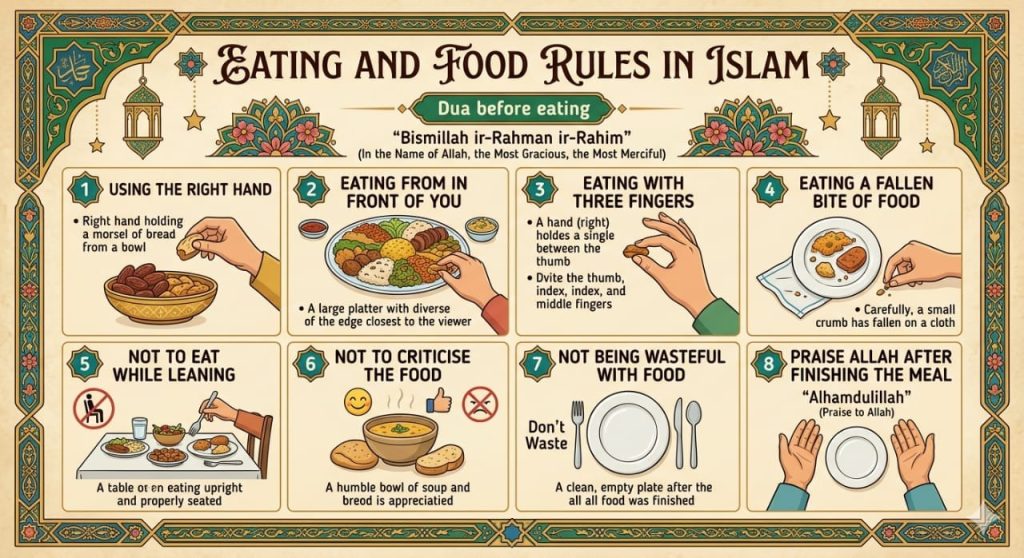
There are recommended Prophetic rules for eating and drinking in islam that we should know and submit to them, those rules are:
ِA. The Prophet Muhammad recommended us to make du’a before eating
In our daily affairs, Prophet Muhammad directs believers to say a specific supplication before eating or drinking.
The dua is very simple, but it gives significant meaning to the person who eats. It should be taught to children from an early age so that they grow up remembering Allah in every matter.
When anyone of you begins eating, say:
With the Name of Allah.
And if you forget then, when you remember, say:
With the Name of Allah, in the beginning, and in the end.
(Hadith)
Ibn ‘Abbas reported God’s messenger as saying,
“When one of you eats food he should say, ‘O God, bless us in it and give us good nourishment from it’, and when he is given a drink of milk he should say, ‘O God, bless us in it and prosper us from it’, for no food or drink satisfies like milk.”
(Hadith)
B- Among the instructions of Islam is using right Hand when eating
The right has always represented virtue, while the left represents badness. We will be portrayed as guilty if it is referred to as the left. Prophet Muhammad taught that one should use the right hand when eating and there is a great benefit in this matter, which is keeping Satan away. Satan eats with a person when they eat or drink with their left hand, but he stays away and does not eat with them when they eat and drink with their right hand.
Ibn Umar narrated that the Messenger of Allah said:
“When one of you eats he should eat with his right hand, and when he drinks he should drink with his right hand, for the devil eats and drinks with his left hand.” Related by Muslim.
(Hadith)
C- Islam asks muslims to eat food that is in front of them
When we eat in a group, we should eat only from the food directly in front of us.
Eating from the middle of the dish or from a place far from us can make others feel uncomfortable or disgusted, and it removes the blessing from the food.
Narrated `Umar bin Abi Salama:
I was a boy under the care of Allah’s Messenger and my hand used to go around the dish while I was eating. So Allah’s Messenger said to me, ‘O boy! Mention the Name of Allah and eat with your right hand, and eat of the dish what is nearer to you.” Since then I have applied those instructions when eating.
(Hadith)
Ibn ‘Abbas (May Allah be pleased with them) reported:
The Prophet (ﷺ) said, “Blessing descends upon food in its middle, so eat from the sides of the vessel and do not eat from its middle.”
(Hadith)
D- Eating with three fingers is one of the Prophetic traditions
The Prophet used to eat with three fingers, but this does not mean it is not permissible for Muslims to use other means of eating. The Prophet said, ‘You are more knowledgeable about your worldly affairs than me.’ However, if it is possible to eat with three fingers, then we are following the Sunnah of the Prophet.
Ibn Ka’b b. Malik reported on the authority of his father that the Messenger of Allah (ﷺ) used to eat (food) with three fingers and he licked his hand before wiping it (with towel).
(Hadith)
E- Prophetic guidance on picking up dropped food and eating it
If a piece of food falls from one of us, the Prophet advised us to pick it up, clean it, wipe it, and then eat it, because we do not know in which part of the food the blessing may be. Perhaps the blessing is in that very piece.
Anas reported that when Allah’s Messenger ate food he licked his three fingers, and he said:
When any one of you drops a mouthful he should remove anything filthy from it and then eat it, and should not leave it for the Satan. He also commanded us that we should wipe the dish saying: You do not know in what portion of your food the blessing lies.
(Hadith)
F- Eating in an upright seated position without reclining as the Prophet Muhammad recommended
The manner of reclining has been differed upon. Al-Hafiz Ibn Hajar said: It has been said that it means to sit firmly for eating in any posture. It has also been said that it means leaning to one side. And it has been said that it means supporting oneself on the left hand from the ground. Al-Khattabi said: The common people think that the one who is “reclining” is the one who eats while leaning on one side, but that is not correct. Rather, it refers to someone who leans on the cushion or bedding beneath him.
Narrated Abu Juhaifa:
Allah’s Messenger said, “I do not take my meals while leaning (against something).
(Hadith)
G- Prophet Muhammad directs not to criticize food but appreciate it
The Prophet advised us never to criticise food or speak ill of it. If we like the food, we eat it; and if we do not want it, we leave it without blaming or insulting it, because it is a blessing from Allah upon us, and we should never belittle it.
Abu Huraira reported that Allah’s Messenger (ﷺ) never found fault with food (served to him). If he liked anything, he ate it, and if he did not like it he left it.
(Hadith)
H- Allah has commanded us not to waste food
The Prophet advised us to eat and enjoy the blessings Allah has given us, but without being wasteful. Allah does not love those who are extravagant and wasteful. This does not only apply to excessive buying or preparing of food, but also to overeating. This has many harms, as the stomach is the home of disease, and eating less brings us great benefit.
Allah almighty says:
O Children of Adam! Dress properly whenever you are at worship. Eat and drink, but do not waste. Surely He does not like the wasteful.
[Quran 7:31 ]
‘Amr b. Shu’aib, on his father’s authority, told that his grandfather reported God’s messenger as saying, “Eat, drink, give sadaqa and wear clothes so long as neither prodigality nor pride is mixed up with it.”
Ahmad, Nasa’i and Ibn Majah transmitted it. (Hadith)
Miqdam bin Ma’dikarib (May Allah be pleased with him) reported:
I heard Messenger of Allah say: “No man fills a container worse than his stomach. A few morsels that keep his back upright are sufficient for him. If he has to, then he should keep one-third for food, one-third for drink and one-third for his breathing.”
(Hadith)
I- From the teachings and virtues of Islam is to praise Allah Almighty after finishing the meal
After finishing the meal, we should praise and thank Allah for granting us this great blessing without any power or ability from us, and for providing us with health and well-being so that we are able to eat.
Anas reported Allah’s Messenger as saying:
When you go to bed, say:” Praise is due to Allah Who fed us, provided us drink, sufficed us and provided us with shelter, for many a people there is none to suffice and none to provide shelter.”
(Hadith)
Is eating pork a major sin in islam?
Yes, eating pork is a major sin in islam and religiously forbidden, and we should never consume pork knowing that Allah has prohibited it for us and Allah has forbidden it in the Quran and the Sunnah.
Also, one of the reasons for its prohibition is its impurity. The pig has very blameworthy characteristics, such as extreme greed, strong desire for what is forbidden, and lack of jealousy (protective honor), so eating it has been prohibited for humans.
Narrated Abu Hurairah:
The Messenger of Allah as saying: Allah forbade wine and the price paid for it, and forbade dead meat and the price paid for it, and forbade swine and the price paid for it.
(Hadith)
What is the punishment for eating pork in islam?
There is no worldly punishment for this act, but if the person does not repent, it remains a grave sin for which Allah will hold them accountable.
Whoever does so must make sincere repentance, return to Allah, feel regret for this action, and not repeat it.
However, if someone does this under compulsion or necessity, without intending to, or does it out of ignorance, there is no blame upon him; then Allah is Most Forgiving and Most Merciful.
Allah Almighty says:
He has only forbidden you ˹to eat˺ carrion, blood, swine,1 and what is slaughtered in the name of any other than Allah. But if someone is compelled by necessity—neither driven by desire nor exceeding immediate need—they will not be sinful. Surely Allah is All-Forgiving, Most Merciful.
[Quran 2:173]
Learn more about the rules of food and drink in Islam
To learn more about the rules of food and drink in Islam, visit our website at explore-islam.com. If you have any other questions related to this topic, feel free to ask us. We would be happy to explain how Islam stands out through its comprehensive guidance, wisdom, and balanced approach to all aspects of life.
Conclusion:
To conclude, Allah has blessed humanity with many provisions in this world and permitted us to enjoy them according to the teachings of the Quran and Sunnah. Food is among these great blessings, and in Islam all foods are lawful except those clearly prohibited. Muslims should follow the Prophetic rules in eating and drinking, such as saying du‘a before eating, using the right hand, eating from what is in front of them, avoiding waste food, and praising Allah after finishing the meal, while also avoiding criticism of food and eating in a mindful, respectful manner.
Islam clearly forbids certain foods and drinks, including pork, carrion, blood, intoxicants, and anything harmful or destructive. These prohibitions must be fully observed, and consuming them is considered a serious sin unless done under compulsion or necessity, in which case there is no blame. All other foods, including vegetables and animals not mentioned among the forbidden categories and properly slaughtered according to Islamic law, are considered halal and permissible for Muslims.
Frequently Asked Questions
1. What are the main eating and food rules in Islam?
The main eating and food rules in Islam require Muslims to consume halal foods and avoid haram (forbidden) foods. Muslims are also encouraged to eat in moderation, express gratitude to Allah, and follow ethical guidelines related to food preparation and consumption.
2. What is the difference between halal and haram food in Islam?
Halal food refers to anything lawful and permissible according to Islamic teachings. Haram food includes items that Allah has prohibited, such as pork, blood, carrion, and food dedicated to anything other than Allah. Understanding halal and haram food in Islam is essential for practicing Muslims.
3. Is eating pork a major sin in Islam?
Yes, eating pork is considered a sin because Allah explicitly prohibited it in the Quran. However, like other sins, sincere repentance is accepted by Allah. The severity of the sin depends on whether a person knowingly and intentionally violates the command.
4. Why is pork forbidden in Islam?
Pork is forbidden because Allah clearly prohibited it in several Quranic verses. Muslims avoid pork primarily out of obedience to Allah’s commands, even beyond any potential health or hygiene considerations.
5. What is the punishment for eating pork in Islam?
Islam does not prescribe a specific worldly punishment for eating pork. However, deliberately consuming what Allah has forbidden is sinful. A Muslim who commits this sin should seek Allah’s forgiveness through sincere repentance and strive to avoid repeating it.
6. What drinks are forbidden in Islam?
All intoxicating drinks, including alcohol, are forbidden in Islam. The prohibition aims to protect individuals and society from the harmful effects of intoxication and impaired judgment.
7. Are all seafood products halal in Islam?
Most Islamic scholars consider seafood permissible, although there are some differences of opinion among certain schools of thought regarding specific marine animals. Generally, fish and many types of seafood are considered halal.
8. Can Muslims eat non-halal food in an emergency?
Yes. Islamic law allows prohibited food to be consumed in cases of necessity when no lawful alternative is available and there is a genuine risk to life or health. This reflects Islam’s principle of preserving human life.
9. Why are Islamic dietary laws important?
Islamic dietary laws help Muslims strengthen their obedience to Allah, maintain spiritual discipline, practice gratitude, and make mindful choices about what they consume. These rules are part of a broader Islamic way of life that promotes purity and responsibility.
10. Do Islamic food rules apply only to food?
No. Islamic dietary guidelines also include beverages, methods of slaughter, food preparation, and ethical consumption. Together, these principles provide a complete framework for lawful and wholesome eating and drinking.