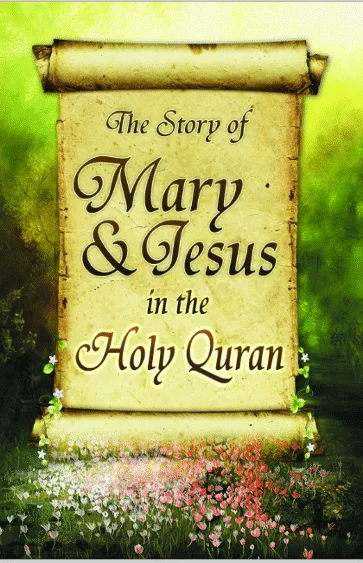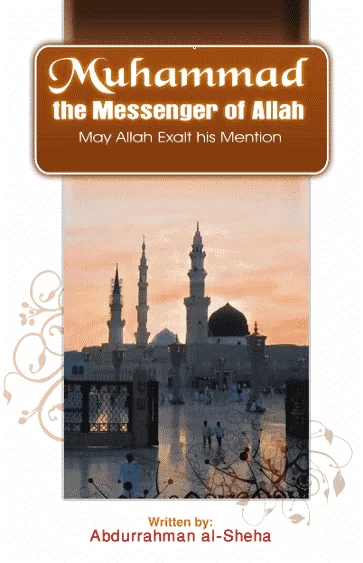
Is the Quran the old testament? Is the old testament in the quran? Do Muslims Follow the Old Testament? As a non-Muslim searching for the truth, these questions and many more might be racing through your mind.
While many assume that a belief in the old testament implies accepting the modern versions found in homes and churches today, the Islamic view involves a different theological distinction. Now, allow me to give you short, clear answers to all of your questions clarifying the true relation between the Quran and the old Testament.
Is the Quran the Old Testament?
No, the Quran is not the old testament, nor is it derived from the old testament or any other book. The Quran is the word of Allah revealed to his final messenger, Muhammad, Peace and Blessings be Upon Him. It is the final message sent to the whole universe to guide mankind to Tawheed (Monotheism).
Does the Quran Include the Old Testament?
Yes, the Quran includes all the benefits of the original divine previous books since they all have the same divine source, plus even more guidance abrogating every early book by the coming of the Quran.
Prophet Muhammad, Peace Be Upon Him said:
“I have been given the seven long (surahs) in place of the Torah, and I have been given the Al-Mi’in (surahs with around 100 verses) in place of the Zabur (Psalms), and I have been given the Al-Mathani (surahs with less than 100 verses) in place of the Injil (Gospel), and I have been favored with the Al-Mufassal (short surahs).”
This prophetic Hadith explains that the Prophet Muhammad was given sections of the Quran that match the wisdom and knowledge of all previous scriptures (the Torah, Gospel, and Psalms). On top of that, he was given an extra gift: the Mufassal (the shorter chapters at the end of the Quran).
In short: Each previous holy divine book has a “matching” part within the Quran. Additionally, Prophet Muhammadr eceived the Mufassal as a special addition that no other Prophet had.
Viewing the Quran as the “Final Testament”
In Islamic theology, the Quran is viewed as the final revelation in a long line of divine revelations. It serves as a “Final Testament” that confirms the truth originally revealed in previous scriptures, such as the Torah/Old Testament and the Injeel (the Gospel).
The Original Torah and Gospel vs. Their Modern Translations
A key point for Muslims when discussing the Quran and the Old Testament is the concept of textual integrity. Muslims believe in the original revelations given to Prophets like Moses and David and maintain a profound regard for the original revelations, viewing them as genuine words of God.
However, the Islamic view is that these original texts are no longer fully intact due to several factors, including:
- Human Intervention to early scriptures: Additions and manipulations over the course of history.
- Translation Filters on old testament: Meaning lost or changed through various translations and re-interpretations.
Do Muslims Follow the Old Testament?
Muslims don’t follow the Old Testament since its original source is changed and abrogated by the final divine revelation of the Quran. The relationship between the Quran and the Old Testament is also one of prophecy and succession. Islam teaches that every revelation includes predictions of future revelations to come. Consequently, Muslims believe that:
1. Believers in previous scriptures are called to accept the new revelation when it arrives.
Prophet Jesus highlights in the Quran that he is a part in divine series preceded by Torah and necessitating his followers to believe in the coming Prophet:
61:6 And [mention] when Jesus, the son of Mary, said,
“O children of Israel, indeed I am the messenger of Allah to you confirming what came before me of the Torah and bringing good tidings of a messenger to come after me, whose name is Ahmad.” But when he came to them with clear evidences, they said, “This is obvious magic.” –
Verse 6 from surah As-Saff – (English – Sahih International)
2. The rejection of one divine book is considered a rejection of all of them.
“The Messenger has believed in what was revealed to him from his Lord, and [so have, the believers. All of them have believed in Allah and His angels and His books and His messengers, (saying), “We make no distinction between any of His messengers.” And they say, “We hear and we obey. [We seek) Your forgiveness, our Lord, and to You is the (final) destination”.
Is the Quran Derived from the Old Testament?
No, the Quran is the word of Allah revealed to his final messenger Muhammed, Peace and Blessings be Upon Him, and it is by no means derived from any other book.
However, there are many reasons for the common things present in the Quran and the previous books. Let’s explore some of these reasons:
1- All Human beings Agree on Common Values:
Ethical values are a common thread among all human beings. When the Quran commands justice, kindness, and charity, and forbids adultery, alcohol, and oppression, it resonates with the Torah and the Gospel because humanity was created with an innate nature (Fitra) that loves good and hates evil.
All humans naturally abhor oppression. Regardless of one’s religion, no one views injustice as a “beautiful” or “noble” trait.
Therefore, similarities in moral commands are not evidence of copying; rather, they reflect a shared human essence and the fact that these messages originated from the same Divine source.
2. The Quran Is a “Guardian” (Muhaymin) on Previous Books:
While previous revelations were sent to specific nations at specific times, the Quran was revealed through Prophet Muhammad as the final message for all of humanity. It acts as a Guardian (Muhaymin) over previous scriptures. This means it:
– Confirms the original, authentic truths remaining in them.
– Corrects the distortions and fabrications that occurred over centuries.
For instance, while earlier scriptures were altered to attribute human limitations or partners to God (such as the claim that God has a son or that His “hand is tied”), the Quran restored the pure concept of Monotheism (Tawhid). It describes God as the One (Al-Ahad), the Self-Sufficient, who neither begets nor is born.
“And We have revealed to you, [O Muhammad], the Book in truth, confirming that which preceded it of the Scripture and as a criterion over it. So judge between them by what Allah has revealed and do not follow their inclinations away from what has come to you of the truth. To each of you We prescribed a law and a method. Had Allah willed, He would have made you one nation [united in religion], but [He intended] to test you in what He has given you; so race to [all that is] good. To Allah is your return all together, and He will [then] inform you concerning that over which you used to differ”.
From the previously mentioned evidence we can conclude that; similarities between the Quran, the Torah, and the Gospel exist because they all originally flowed from the same spring: The Lord of the Worlds.
While previous books were subject to human interference, the Quran remains preserved and protected, serving as the final criterion for truth.
“Indeed, it is We who sent down the Qur’an and indeed, We will be its guardian”.
For more information on the origin of the Holy Quran read: Who wrote the Quran? The Truth Behind the Author of the Quran
Does The Quran Contradict The Torah and Bible? Understanding the Islamic Perspective
In fact, there is no contradiction between the Quran, and the original uncorrupted forms of the Torah and the Bible, since they all come from the same origin and call to the same belief, which is Tawheed (Monotheism). Allah the Almighty says in the Quran, Surah Al-Imran:
“Allah – there is no deity except Him, the Ever-Living, the Sustainer of existence”.
“He has sent down upon you, [O Muhammad], the Book in truth, confirming what was before it. And He revealed the Torah and the Gospel”.
“Before, as guidance for the people. And He revealed the Qur’an. Indeed, those who disbelieve in the verses of Allah will have a severe punishment, and Allah is exalted in Might, the Owner of Retribution”.
However, the contradiction arose due to human interference with the original scriptures of the Torah and Bible. Thus, Allah mentioned those who write the scripture and claim it is from Him in Surah Al-Baqarah-Verse 79:
“So woe to those who write the “scripture” with their own hands, then say, “This is from Allah,” in order to exchange it for a small price. Woe to them for what their hands have written and woe to them for what they earn”. (Surah Al-Baqarah – 79, Sahih International).
“These observations relate to their rabbis. They were not content with misinterpreting the Word of God. They also interjected into it their readings of the Scriptures and their explanatory comments thereof, stories from their national history, superstitious ideas and fancies, philosophical doctrines and legal rules.
The result was that the Divine and the human became inextricably mixed. They claimed, nevertheless, that the entire thing was divine! Every historical anecdote, the interpretation of every commentator, the doctrine of every theologian, and the legal deduction of every jurist that managed to find its way into the Bible became the ‘Word of God’. It was thus obligatory to believe in all that, and every deviation from it became tantamount to deviation from the true faith.”
Resolving Contradictions between the Quran, the Torah, and the Bible!
From the Islamic viewpoint, if the original texts of the Old Testament had remained perfectly preserved, there would be no contradictions between the biblical narrative and the Quranic narrative. Therefore, the Quran is used as a “criterion” to confirm what remains of the truth and identify where previous texts may have been altered.
Which religion is true Islam or Christianity?
In the light of what we have dicussed in this article it becomes obvious that the question, “which is the true religion, Islam or Christianity?” is not actually a valid one, since it assumes the existence of more than one religion, which is not true.
This means that all the prophets were actually sent with the same divine message of Monotheism. Allah says in the Quran, Surah Al Imran, verse 19:
“إِنَّ الدِّينَ عِندَ اللَّهِ الْإِسْلَامُ ۗ وَمَا اخْتَلَفَ الَّذِينَ أُوتُوا الْكِتَابَ إِلَّا مِن بَعْدِ مَا جَاءَهُمُ الْعِلْمُ بَغْيًا بَيْنَهُمْ ۗ وَمَن يَكْفُرْ بِآيَاتِ اللَّهِ فَإِنَّ اللَّهَ سَرِيعُ الْحِسَابِ”
“Indeed, the religion in the sight of Allah is Islam. And those who were given the Scripture did not differ except after knowledge had come to them – out of jealous animosity between themselves. And whoever disbelieves in the verses of Allah, then indeed, Allah is swift in [taking] account”.
Quran Vs Old Testament: Comparison Table
So, what are the differences between the Holy Quran and the old testament? Let me summarize the main points of difference in the following comparison table:
| Feature | The Holy Quran | The Old Testament |
| Source & Nature | Divine revelation; the final “Guardian” (Muhaymin) over previous books. | Viewed by critics as a source of “legends” or a human-edited text prone to alteration. |
| Linguistic Style | The pinnacle of eloquence, rhetoric, and sobriety; free from linguistic “clumsiness.” | Described as having a “weak” or “clumsy” style that can descend into “vulgarity.” |
| Concept of God | Absolute Monotheism (Tawhid); God is characterized by absolute perfection, knowledge, and power. | Anthropomorphic; God is depicted as needing rest, feeling regret, having limited knowledge, or needing physical signs. |
| Infallibility of Prophets | Prophets are the “elite of humanity” divinely protected from committing sins or moral indecencies. | Prophets are depicted as non-infallible; accused of intoxication, lying, adultery, and even idolatry. |
| Nature of Angels | Beings of light who do not eat, drink, or disobey Allah. | Depicted as eating and drinking (e.g., consuming butter, meat, and milk). |
| Consistency | Consistent and free from internal contradictions or “fables.” | Contains numerous historical, numerical, and theological contradictions. |
| Universal Reach | A final message intended for all of humanity across all times. | Originally sent to specific nations or tribes for specific periods. |
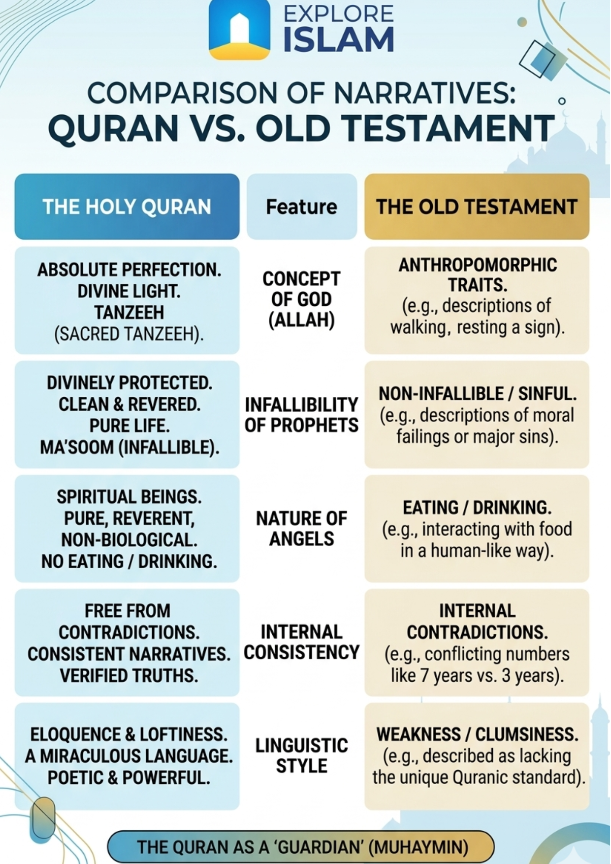
Summary of Key Theological Divergences Between the Quran and Old Testament
-The Divine Self: The Quran refutes the Old Testament’s claim that God rested on the seventh day, stating that “no weariness” touched Him.
-Different narrations: The Golden Calf story: The Quran vindicates Prophet Aaron, placing the blame on As-Samiri, whereas the Old Testament attributes the making of the idol to Aaron.
-Prophetic Honor: The Quran cleanses the biographies of Prophets like Noah, Abraham, Lot, and David from the “vile crimes” attributed to them in the Old Testament accounts.
Summary
In this article, we answered many questions including; Is the Quran the old testament? Does the Quran have the old testament? And whether the Quran contradicts the old testament or not.
To wrap this up we first have to clarify that the Quran is not the old testament, nor is it copied from the old testament or any other scripture. The Holy Quran is the word of Allah and his final message revealed to Prophet Mohammad, Peace Be Upon Him, to guide humanity to the worship of Allah alone.
In conclusion, while the Quran, Torah, and Gospel share a common divine origin, the Quran stands alone as the final, protected revelation from Allah. It does not incorporate the Old Testament as it exists today; instead, it acts as the Muhaymin (Guardian and Criterion), confirming the original truths sent to previous prophets while correcting the human interpolations that occurred over time.
For a seeker of truth, the relationship is one of completion rather than contradiction. The Quran restores the pure monotheism and prophetic honor that were central to the original messages, providing a universal and perfectly preserved guide for all of humanity. Following the Quran is not a rejection of the previous prophets, but the ultimate fulfillment of their original teachings.
Do you still have questions regarding the Islamic belief and the Quran? Explore Islam team is always glad to guide you through your journey to the truth. Do not hesitate to reach out to us through a message or subscribe to our newsletter for more insights on islam.
References
What Do Muslims Believe about Bible?