Have you ever faced a difficult situation and found yourself caught between two thoughts? On one hand, you hear the comforting reminder, “God has a plan,” and on the other, a voice inside insists, “But you have to make a choice.” This tension between divine decree and human free will is a universal question, one that lies at the very heart of faith.
For believers, it can be a source of both peace and confusion. If God is truly in control, where do our choices fit in? Are we merely actors following a script, or do our decisions genuinely shape our destiny? And if our choices matter, how do we reconcile human error and evil with a perfectly wise and merciful God?
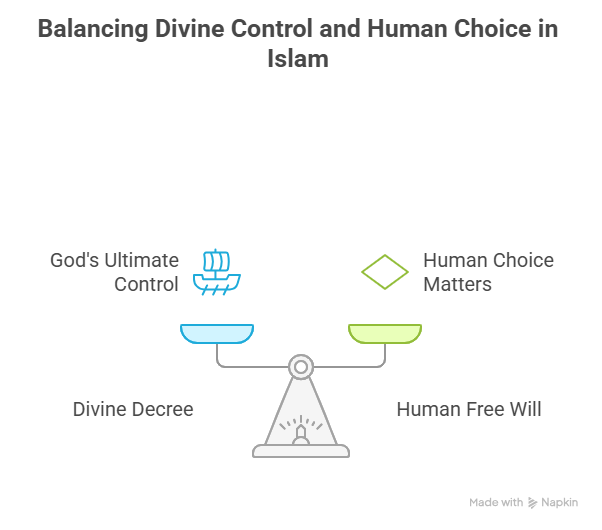
In Islam, the answer is not one or the other, but a balance between both truths. Here we will discuss the Islamic perspective, revealing how Allah’s ultimate control and our God-given free will coexist, not as a contradiction, but as a testament to His perfect justice, wisdom, and love.
God is in Control: The Source of All Sovereignty and Peace
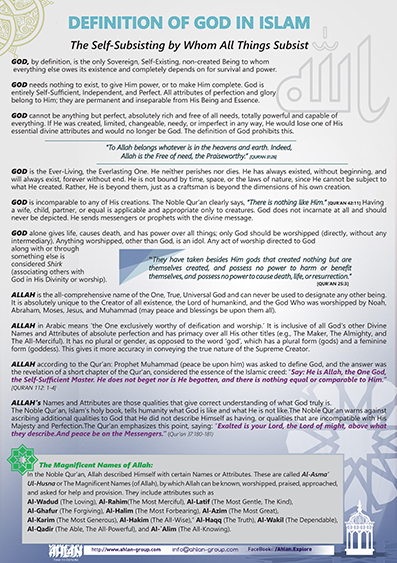
Allah is known as Al-Muhaymin—the Guardian, the Witness, the One who has full authority and knowledge. He observes, protects, and knows everything we go through. When we turn to Him, He is the One who guides us through life’s tests via the revelation sent to the Messenger of Allah, Muhammad (PBUH).
We often crave control, but true peace comes from trusting Allah’s perfect plan. When you feel like you’re losing control, remember—you’re surrendering to the One who controls everything.
Verses about God being in control:
The Quran beautifully captures His supreme attributes in the following verses:
- “He is Allah—there is no god except Him: the King, the Most Holy, the Source of Serenity, the Guardian of Faith, the Almighty, the Irresistible, the Supreme.” [Quran 59:23]
- “To whomsoever among you who wills to walk straight. And you cannot will unless (it be) that Allâh wills – the Lord of the ‘Âlamîn (mankind, jinn and all that exists).” [Quran 28,29:81]
God’s Knowledge doesn’t contradict with Granting human Freedom of Choice
This leads to a common question: If Allah already knows what we will choose, is our freedom an illusion?
The answer is no. Allah’s prior knowledge does not force our hand. As the Creator, it is no wonder that He knows His creation perfectly. He knew and wrote our fate in the Preserved Tablet (Al-Lawh Al-Mahfudh), but this knowledge is hidden from us.
The Quran affirms this all-encompassing knowledge:
أَلَا يَعْلَمُ مَنْ خَلَقَ وَهُوَ اللَّطِيفُ الْخَبِيرُ
“How could He Who created not know His own creation, when He is the Knower of subtleties, the All-Aware?”
Allah knows the final outcome, but we are walking the path through our own choices. He does not force us; He gives us the book of guidance and the test of life, and we are the ones who strive.
Evil, Suffering, and Natural Disasters are manifestations of life test and human choice
The Problem of Evil: If God is in control, is He responsible for suffering?
The Quran states that all things come from Allah, but calamities often befall humans as a result of their own sins and disobedience. Scholars explain that while Allah decrees everything, He grants free will, and our choices bring about consequences. The Prophet (PBUH) taught that hardships can serve as a purification, as in the hadith:
‘The believer is not afflicted by any hardship… except that Allah expiates his sins because of it.’
(Sahih al-Bukhari)
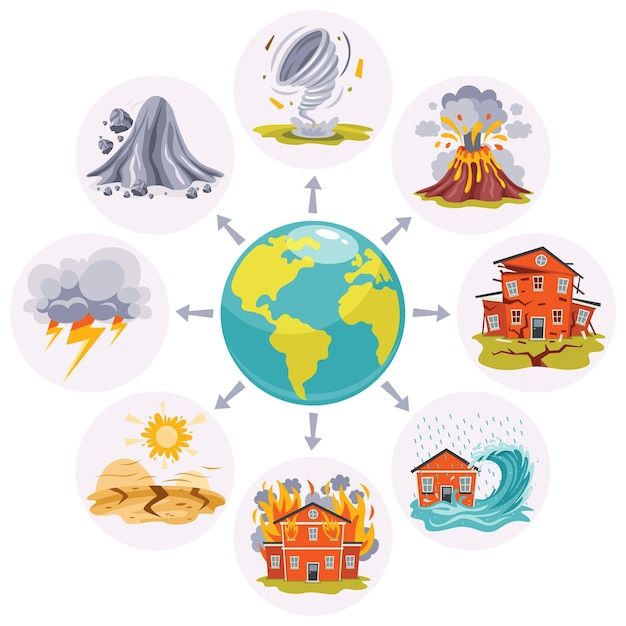
What about Natural Disasters?
Events like earthquakes and hurricanes are part of Allah’s way (Sunnah) on Earth. They are described as “soldiers of Allah” that serve profound wisdoms: as a reminder of His might, a warning to the disobedient, or a punishment. While they can affect anyone, the status of the believers and disbelievers who die in them is vastly different. A believer who dies in such a catastrophe may be considered a martyr, as the Prophet (PBUH) said:
“The martyrs are seven besides one killed in Allah’s cause:… a person who dies in a collapse (e.g., earthquake) is a martyr.”
(Sunan an-Nasa’i)
Why Striving Matters
Allah has embedded a system of causes and effects in the world. Studying hard is the means to academic success; pious deeds are a means to increased provision. However, these causes are not independent; they are entirely subject to Allah’s will.
He may strengthen a cause, nullify it, or prevent its usual effect to teach us that nothing happens outside of His will. A student who studies hard may still fail due to a hidden wisdom—perhaps to protect them from arrogance or due to a major sin that blocked blessings. This reinforces that while we must use the means, the ultimate outcome rests with Allah.
The believer’s attitude is beautifully summarized by the Prophet (PBUH):
‘How wonderful is the affair of the believer, for all his affairs are good. If something good happens to him, he is thankful, and that is good for him. If something bad happens, he bears it with patience, and that is good for him.’
(Sahih Muslim)
God’s Love: Relational Yet Uncontrolling
A key to understanding this balance is the nature of God’s love in Islam. Allah’s love is both personal and purposeful.
- It is Relational: The Quran repeatedly connects Allah’s love to human choice and action.
“Indeed, Allah loves the doers of good.” (Quran 2:195)
“Indeed, Allah loves those who repent…” (Quran 2:222)
This shows a relationship built on our moral and spiritual state. He draws near to those who seek Him, as in the Hadith Qudsi: ‘When My servant draws near to Me a hand’s length, I draw near to him an arm’s length…’ (Sahih al-Bukhari) - It is Uncontrolling: Allah’s wisdom dictates that He grants free will. He could have forced belief, but His love is not coercive. Genuine love, obedience, and goodness must be chosen.
“If Allah had willed, He would have made you one nation; but He lets go astray whom He wills and guides whom He wills.” (Quran 16:93)
Allah’s response to human failure is not to seize brute control, but to extend mercy, invitation, and forgiveness. He laments our missteps and delights in our return, as the Prophet (PBUH) said:
‘Allah is more pleased with the repentance of His servant than one of you who finds his lost camel in the desert.’
(Sahih Muslim)
Conclusion
To conclude, the Islamic answer to the question of “is God in control” is: Both are true in a majestic, divine balance.
When we say, “Allah is in control,” we mean He is the Sovereign Lord of the universe, and His plan is ultimately perfect. This truth calls for surrender, trust, and peace.
When we acknowledge our free will, we accept our role as morally responsible agents. This truth calls for action, striving, and accountability.
Therefore, “God is in control” is not a call to passivity. It is a call to active surrender—to strive as if everything depends on us, and to trust as if everything depends on Him. We are to work, choose, repent, and serve, all while having full confidence that our lives are in the hands of the Most Merciful, the Most Just, and the All-Wise.
This is the path to a balanced faith, where responsibility meets serenity, and where our choices become the very means through which we draw closer to our Lord.
This article mentioned that Allah’s response to our choices is mercy and invitation. What does that divine mercy truly look like? Explore the infinite scope of Allah’s forgiveness in our next article.
[Islam is the Religion of Mercy – Your Next Read Awaits]