If God has already written everything, why are we held accountable? This question echoes through many minds, often attempting to confine Islam within the category of ‘Absolute Fatalism. The Divine Decree is not a script that coerces the individual; rather, it is a manifestation of God’s omniscience. In the Islamic worldview, human dignity is predicated on the ability to choose, and the Creator’s justice is reflected in the fact that accountability is tied strictly to that choice.
In this article, we will analyze the concept of Free Will in Islam as a profound testament to the Creator’s absolute justice and the inherent greatness of human dignity. By examining the primary sources of the Faith, we will explore how Islam harmonizes the sovereignty of God with the liberty of man, illustrating that while God knows our destination, He has granted us the reins to navigate the path.
Does Islam Believe in Free Will?
Yes, Islam believes in human free will in their choices preceded by the divine Will for humans to have a choice, and as a manifestation of Almighty God’s omniscience and justice. Still, human will is not absolute and limited to parts of life connected to their life test necessitating free will, while other parts are only divine and controlled by absolute wisdom, such as the time of death and lineage.
The core principles of this understanding include distinguishing between God’s pre-knowledge and predestination to show that knowing an outcome does not force human action, recognizing that the Qur’an presents paths of good and evil while leaving humans free to choose, understanding that accountability is based on reason, capacity, and intent, and appreciating the balance expressed in the verse, “For whoever wills among you to take a right course. And you do not will except that Allah wills” (81:28-29), which harmonizes human free will with divine wisdom. Believing in this balance empowers the believer to act with purpose while maintaining peace regarding the outcomes.
Absolute divine Knowledge doesn’t contradict human free will
The confusion often arises from mixing up knowledge with compulsion. In Islamic theology, the recording of destiny in the Preserved Tablet reflects Allah’s complete knowledge of what each servant will choose, but it does not force them to act. Allah’s knowledge is “Revealing” (Kashif), not “Causative” (Mujib), meaning He knows outcomes without causing them.
As Sheikh As-Sa’di explains in his commentary on verse 70 of Surah Al-Hajj, Allah’s knowledge encompasses everything before it occurs and is recorded in the Preserved Tablet. This divine knowledge does not compel the servant’s actions; it simply reflects the Creator’s awareness of what the servant will freely choose.
An illustrative example is a teacher who predicts that a diligent student will succeed on an exam. The teacher’s knowledge and recording of this outcome does not cause the success; it merely reflects insight into the student’s efforts. Similarly, Allah’s foreknowledge does not override human free will.
Read more about the identity of Islam!
Almighty God Enables Humans with Will and Capacity for Voluntary Actions
To understand human accountability in Islam, we must recognize the role of human choice in actions, known in Islamic theology as “Kasb” (Acquisition). Allah is the Creator of both the capacity and the action, while humans are responsible for the direction and intent of their choices. This means accountability is tied to the intentional exercise of free will—the moment a person directs their will toward an action.
As Sheikh As-Sa’di explains in his commentary on Surah Al-Baqarah, every servant possesses a will and capacity, and their reward or punishment is linked to what they “acquire” through their voluntary actions. This aligns with the Qur’anic principle:
“Allah does not burden any soul beyond what it can bear. It will have [the consequence of] what it earned, and it will bear [the consequence of] what it committed.”
In Islam, this shows that free will is meaningful and purposeful: humans are empowered to choose, but within the scope of divine wisdom and justice, ensuring that accountability is both fair and reasonable.
Read: Does Islam believe in Abraham (PBUH)?
Free Will as the Basis for Accountability In Islam
In Islam, free will is the foundation of all religious obligation. Without the ability to choose, reward and punishment would have no meaning, since humans would not be responsible for their actions. This affirms that each person is the intender of their own deeds.
As Sheikh As-Sa’di explains in his commentary on Surah Al-Kahf, Allah made belief and disbelief a matter of choice for His servants so that accountability could be established:
“˹This is˺ the truth from your Lord. Whoever wills let them believe, and whoever wills let them disbelieve.”
This shows that human free will is essential for moral responsibility, as every individual is tested according to the choices they make.
The Relation Between the Divine Will and Human Will
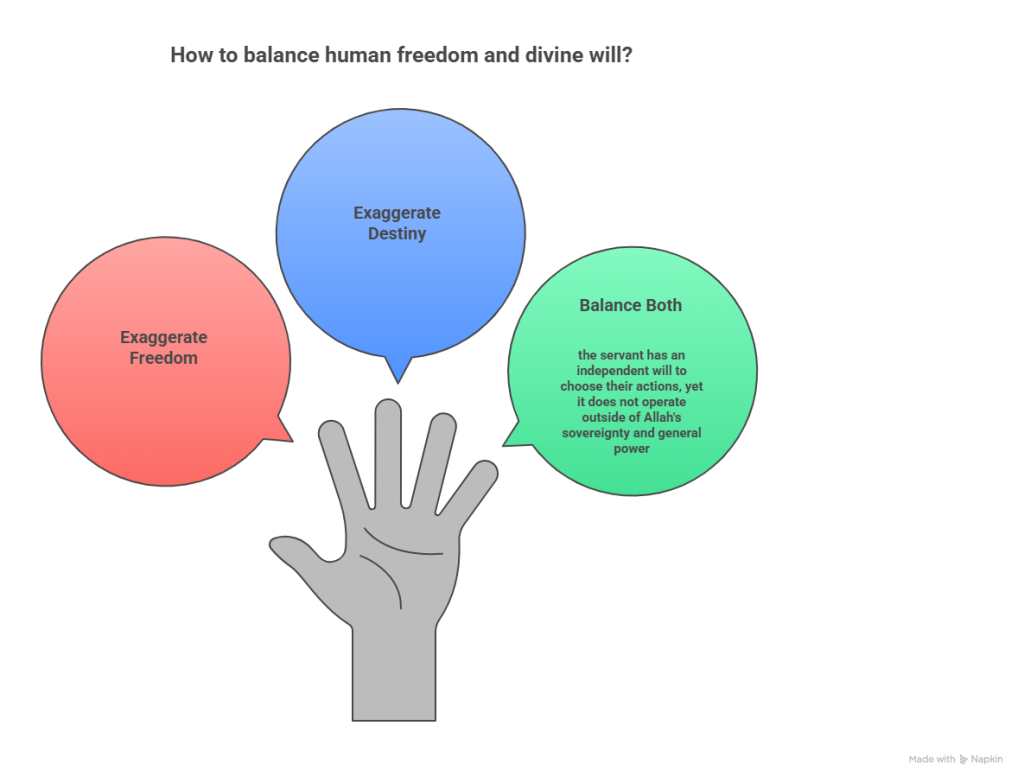
Islam teaches that human free will exists within the framework of Allah’s absolute power. Humans can choose their actions, but their will operates under Allah’s sovereignty and general will.
The Qur’an states:
“To whoever of you wills to take the Straight Way. But you cannot will ˹to do so˺, except by the Will of Allah, the Lord of all worlds.”
(81:28–29)
This shows that human choice and divine will work together: humans are responsible for their decisions, yet all actions remain under Allah’s ultimate control.
Destiny and God’s Absolute Justice in Islam
One must acknowledge the limitations of the human mind before absolute Divine Wisdom to understand the concept of destiny in Islam. God (Allah) does not wrong His servants; rather, He recompenses them for what they have done. Destiny is a secret that does not prevent a human from striving. The complete union between Allah’s knowledge and human freedom remains in the realm of the Unseen, about which Allah says: “He cannot be questioned about what He does, but they will ˹all˺ be questioned.”
Almighty God in Islam cannot be questioned about what He does, but they will ˹all˺ be questioned
Allah wrote the destinies because He is “All-Knowing,” and He holds us accountable for our actions because we are “Volitional.” The argument against us is not Allah’s knowledge—which is hidden from us—but our own manifest will through which we initiated our actions; therefore, He said: “Your Lord is never unjust to ˹His˺ creation”
[Fussilat: 46].
Whoever does good, it is to their own benefit. And whoever does evil, it is to their own loss. Your Lord is never unjust to ˹His˺ creation.
Read also:
Conclusion
To conclude, the article explores the question of does Islam believe in free will, analyzing the relation between divine Will and human will in Islamic belief.
- Divine Knowledge is not Compulsion: Distinguishing between God’s “Pre-knowledge” (as a record) and “Predestination” (as a coercive force).
- The Gift of Free Will in Islam: Examining how the Quran outlines the two paths (good and evil) while leaving the direction to human choice.
- The Basis of Accountability: Understanding how “Reason,” “Capacity,” and “Intent” form the three pillars of Divine Justice.
- Human Will within Divine Will: Exploring the delicate balance of the verse: “For whoever wills among you to take a right course. And you do not will except that Allah wills” (81:28-29).
If you still have further questions, start a fruitful conversation with our team right now for more discussion!