| Key Takeaways |
| Prophet Muhammad (PBUH) is a direct descendant of Prophet Ibrahim (Abraham) through his son Ismail (Ishmael), making their relationship both biological and prophetic. |
| The lineage of Prophet Muhammad (PBUH) is documented in Islamic scholarship through an unbroken chain tracing back to Ismail, then to Ibrahim. |
| Ibrahim (AS) prayed explicitly for a prophet to be sent from his descendants in Makkah — a supplication fulfilled centuries later in the birth of Muhammad (PBUH). |
| Both Ibrahim and Muhammad (PBUH) are central figures in Islam’s understanding of Tawhid (the oneness of Allah) and prophethood, connected by lineage, mission, and divine covenant. |
| The Quran affirms the shared prophetic mission of Ibrahim and Muhammad (PBUH), placing them at the heart of Islam’s universal message to all humanity. |
Ibrahim (AS) — known in English as Abraham — is one of the greatest prophets in Islamic history, and Prophet Muhammad (PBUH) is Ibrahim’s direct biological descendant. The connection runs through Ibrahim’s son Ismail (AS), the ancestor of the Arab tribes from whom the Prophet (PBUH) emerged centuries later.
This lineage places Prophet Muhammad (PBUH) at the fulfillment of Ibrahim’s own supplication to Allah — a prayer recorded in the Quran for a prophet to rise among his descendants in the sacred land of Makkah.
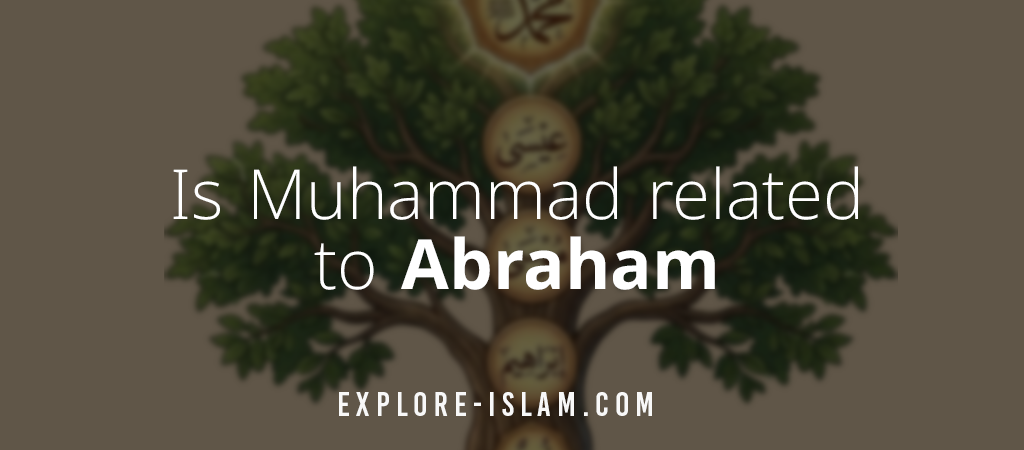
Is Muhammad Related to Abraham?
Yes — Prophet Muhammad (PBUH) is directly related to Ibrahim (AS) by blood. The genealogical chain recorded in classical Islamic scholarship connects the Prophet (PBUH) to Ibrahim through his son Ismail ibn Ibrahim (AS), across an unbroken patrilineal line spanning approximately 40 generations.
Islamic tradition preserves the full genealogical chain. Ibn Hisham’s Sirah al-Nabawiyyah — one of the earliest and most authoritative biographical sources on the Prophet (PBUH) — records the lineage as: Muhammad ibn Abdallah ibn Abd al-Muttalib ibn Hashim, continuing through the Quraysh tribe, through Adnan, and ultimately back to Ismail ibn Ibrahim (AS).
The Prophet (PBUH) himself acknowledged this descent, as recorded in authenticated narrations, describing his origin as from the noblest lineage among the Arabs.
What is the Genealogical Chain of Prophet Muhammad (PBUH) to Ibrahim (AS)?
Muhammad (PBUH) → Abdallah → Abd al-Muttalib → Hashim → Abd Manaf → Qusayy → Kilab → Murra → Ka’b → Lu’ayy → Ghalib → Fihr (Quraysh) → Malik → al-Nadr → Kinanah → Khuzaymah → Mudrikah → Ilyas → Mudar → Nizar → Ma’add → Adnan — and from Adnan, ascending through documented Arab ancestral lines to Ismail ibn Ibrahim (AS).
Scholars of Islamic genealogy note that the section from Muhammad (PBUH) to Adnan is agreed upon in authentic Islamic sources.
The portion from Adnan to Ismail is also affirmed, though the precise number of generations between them carries some scholarly discussion.
What Islamic scholarship unanimously affirms is the essential fact: the lineage of Muhammad (PBUH) connects to Ismail, and through Ismail, to Ibrahim (AS).
The Prophet Muhammad (PBUH) as the Direct Answer to Ibrahim’s Supplication
The relationship between Ibrahim (AS) and Muhammad (PBUH) is not merely genealogical — the Quran presents it as divinely ordained from the moment Ibrahim raised the foundations of the Kaaba in Makkah.
Together with his son Ismail, Ibrahim made a supplication recorded in Surah Al-Baqarah:
رَبَّنَا وَابْعَثْ فِيهِمْ رَسُولًا مِّنْهُمْ يَتْلُو عَلَيْهِمْ آيَاتِكَ وَيُعَلِّمُهُمُ الْكِتَابَ وَالْحِكْمَةَ وَيُزَكِّيهِمْ ۚ إِنَّكَ أَنتَ الْعَزِيزُ الْحَكِيمُ
“Our Lord, and send among them a messenger from themselves who will recite to them Your verses and teach them the Book and wisdom and purify them. Indeed, You are the Exalted in Might, the Wise.”
(Quran 2:129)
This is Ibrahim’s explicit prayer for a prophet from among the Arab descendants of Ismail.
The Prophet Muhammad (PBUH) understood himself as the direct answer to this supplication. In an authenticated narration recorded by Imam Ahmad, the Prophet (PBUH) said:
“I am the supplication of my father Ibrahim, and the glad tidings of ‘Isa (Jesus), and my mother saw a light when she delivered me that illuminated the palaces of Syria.”
This hadith is remarkable in its layered meaning: Ibrahim prayed for him, ‘Isa (AS) foretold his coming, and his birth carried divine light — a convergence of three prophets across history, united in a single mission.
Ismail Was the Link Between Ibrahim and Muhammad (PBUH)
Understanding how Muhammad (PBUH) is related to Ibrahim (AS) requires understanding Ismail (AS) — the son through whom that lineage flows.
When Ibrahim (AS) brought Hajar and the infant Ismail to the barren valley that would become Makkah, this act established the ancestral home of the Arab people descended from Ismail.
Ismail (AS) grew up in Makkah, married among the Arab tribes of Jurhum, and his descendants became the Arab tribes of the Hijaz — including, centuries later, the noble tribe of Quraysh, and within Quraysh, the clan of Banu Hashim. It is from Banu Hashim that Prophet Muhammad (PBUH) was born.
The Quran honors Ismail (AS) repeatedly, identifying him as a prophet, a man of his word, and one who submitted fully to Allah’s command — including the trial of sacrifice alongside his father. Allah says in Surah Maryam:
وَاذْكُرْ فِي الْكِتَابِ إِسْمَاعِيلَ ۚ إِنَّهُ كَانَ صَادِقَ الْوَعْدِ وَكَانَ رَسُولًا نَّبِيًّا
“And mention in the Book, Ishmael. Indeed, he was true to his promise, and he was a messenger and a prophet.”
(Quran 19:54)
Ismail (AS) represents the direct ancestral bridge: son of Ibrahim, forefather of Muhammad (PBUH). His character — faithfulness, submission, and prophethood — prefigures the qualities that would reach their fullest expression in the final prophet of Islam.
Ibrahim and Muhammad (PBUH) Shared a Mission Across Time
The lineage between Ibrahim (AS) and Muhammad (PBUH) reflects something deeper than genealogy — a continuity of divine mission. Ibrahim (AS) and Muhammad (PBUH) called humanity to the pure worship of Allah alone, both built or restored the sacred house in Makkah, and both were given covenants by Allah that transcended their own lifetimes.
The Quran explicitly honors Ibrahim as one of the original carriers of Islam’s essential message — Tawhid, the absolute oneness of Allah. Ibrahim rejected the idol worship of his people, as recorded throughout the Quran, and submitted himself entirely to Allah. Allah says in Surah Al-Baqarah:
رَبَّنَا وَٱجْعَلْنَا مُسْلِمَيْنِ لَكَ وَمِن ذُرِّيَّتِنَآ أُمَّةً مُّسْلِمَةً لَّكَ وَأَرِنَا مَنَاسِكَنَا وَتُبْ عَلَيْنَآ ۖ إِنَّكَ أَنتَ ٱلتَّوَّابُ ٱلرَّحِيمُ ﴿١٢٨﴾ رَبَّنَا وَٱبْعَثْ فِيهِمْ رَسُولًا مِّنْهُمْ يَتْلُوا۟ عَلَيْهِمْ ءَايَٰتِكَ وَيُعَلِّمُهُمُ ٱلْكِتَٰبَ وَٱلْحِكْمَةَ وَيُزَكِّيهِمْ ۚ إِنَّكَ أَنتَ ٱلْعَزِيزُ ٱلْحَكِيمُ ﴿١٢٩﴾ وَمَن يَرْغَبُ عَن مِّلَّةِ إِبْرَٰهِـۧمَ إِلَّا مَن سَفِهَ نَفْسَهُۥ ۚ وَلَقَدِ ٱصْطَفَيْنَٰهُ فِى ٱلدُّنْيَا ۖ وَإِنَّهُۥ فِى ٱلْـَٔاخِرَةِ لَمِنَ ٱلصَّٰلِحِينَ ﴿١٣٠﴾ إِذْ قَالَ لَهُۥ رَبُّهُۥٓ أَسْلِمْ ۖ قَالَ أَسْلَمْتُ لِرَبِّ ٱلْعَٰلَمِينَ ﴿١٣١﴾ وَوَصَّىٰ بِهَآ إِبْرَٰهِـۧمُ بَنِيهِ وَيَعْقُوبُ يَٰبَنِىَّ إِنَّ ٱللَّهَ ٱصْطَفَىٰ لَكُمُ ٱلدِّينَ فَلَا تَمُوتُنَّ إِلَّا وَأَنتُم مُّسْلِمُونَ
“Our Lord, and make us Muslims [in submission] to You and from our descendants a Muslim nation [in submission] to You. And show us our rites and accept our repentance. Indeed, You are the Accepting of repentance, the Merciful. (128) Our Lord, and send among them a messenger from themselves who will recite to them Your verses and teach them the Book and wisdom and purify them. Indeed, You are the Exalted in Might, the Wise.” (129) And who would be averse to the religion of Abraham except one who makes a fool of himself. And We had chosen him in this world, and indeed he, in the Hereafter, will be among the righteous. (130) When his Lord said to him, “Submit”, he said “I have submitted [in Islam] to the Lord of the worlds.” (131) And Abraham instructed his sons [to do the same] and [so did] Jacob, [saying], “O my sons, indeed Allah has chosen for you this religion, so do not die except while you are Muslims.”
(Quran 2:127-132)
Muhammad (PBUH) was commanded to follow the millah — the way — of Ibrahim (AS), restoring the pure monotheism that had been distorted by centuries of deviation.
The Quran describes Ibrahim as neither Jewish nor Christian, but a hanif — one who turns sincerely to Allah — and a Muslim in the fullest sense:
مَا كَانَ إِبْرَاهِيمُ يَهُودِيًّا وَلَا نَصْرَانِيًّا وَلَٰكِن كَانَ حَنِيفًا مُّسْلِمًا وَمَا كَانَ مِنَ الْمُشْرِكِينَ
“Abraham was neither a Jew nor a Christian, but he was one inclining toward truth, a Muslim [submitting to Allah]. And he was not of the polytheists.”
(Quran 3:67)
This verse — one of the clearest in the Quran on Ibrahim’s identity — connects directly to how Islam understands the belief in one God as the clear path to salvation: the path that Ibrahim walked, and that Muhammad (PBUH) completed and sealed for all humanity.
The Kaaba is Where Ibrahim and Muhammad (PBUH) Meet in Sacred History
One of the most tangible expressions of the Ibrahim–Muhammad (PBUH) lineage is the Kaaba in Makkah — the sacred house that Ibrahim and Ismail built together, and toward which every Muslim on earth turns in prayer to this day.
The Quran records the moment Ibrahim and Ismail raised its foundations:
وَإِذْ يَرْفَعُ إِبْرَاهِيمُ الْقَوَاعِدَ مِنَ الْبَيْتِ وَإِسْمَاعِيلُ رَبَّنَا تَقَبَّلْ مِنَّا ۖ إِنَّكَ أَنتَ السَّمِيعُ الْعَلِيمُ
“And [mention] when Abraham was raising the foundations of the House and [with him] Ishmael, [saying], ‘Our Lord, accept [this] from us. Indeed, You are the Hearing, the Knowing.'”
(Quran 2:127)
Centuries later, Prophet Muhammad (PBUH) was born and raised in the same city — in Makkah — a direct descendant of the man who built that sacred house.
When the Prophet (PBUH) later cleansed the Kaaba of idols upon the conquest of Makkah, he was restoring the house of his ancestor Ibrahim (AS) to the worship for which it was built.
Explore More Authentic Knowledge About Islam with Explore Islam Platform
Explore Islam exists for exactly these questions — the ones that seek to understand Islam clearly, honestly, and without distortion.
Whether you are exploring Islam for the first time, correcting a misconception you encountered, or seeking deeper understanding of the prophets and their connections — you have come to the right place.
Browse the full library of Explore Islam articles and resources for in-depth coverage of Islamic beliefs, history, and answers to common questions.
Explore books and written resources and video content for a richer, multimedia understanding of Islam.
Every question is welcome. Every seeker is valued.
Reach out directly — all questions welcome
Summary
Prophet Muhammad (PBUH) descends from Ibrahim (AS) through Ismail — a lineage spanning generations, documented in classical Islamic biography, affirmed by Quranic revelation, and rooted in the sacred history of Makkah. Ibrahim’s prayer for a prophet from his descendants was answered in the birth of the final prophet of Islam.
The connection carries meaning far beyond ancestry. Both prophets embodied the same essential call — pure worship of Allah alone — across different eras, different peoples, and different divine dispensations. In Muhammad (PBUH), the mission Ibrahim began was completed, sealed, and delivered to all of humanity.
Frequently Asked Questions
Is Prophet Muhammad (PBUH) a descendant of Abraham according to the Quran?
The Quran does not list the full genealogical chain, but it affirms the prophetic and biological connection clearly. Ibrahim prayed in Quran 2:129 for a prophet from his descendants in Makkah — a supplication fulfilled in Muhammad (PBUH), who descended from Ibrahim through his son Ismail. Islamic scholarship treats this lineage as established fact.
Through which son of Abraham does Muhammad (PBUH) descend — Isaac or Ishmael?
Prophet Muhammad (PBUH) descends through Ismail (Ishmael), not Ishaq (Isaac). Ismail was brought to Makkah as an infant, grew up among the Arab tribes, and his descendants became the Arab peoples of the Hijaz — including the tribe of Quraysh and the clan of Banu Hashim, into which the Prophet (PBUH) was born.
Did Prophet Muhammad (PBUH) consider himself connected to Abraham’s mission?
Yes — the Prophet (PBUH) explicitly identified himself as the fulfillment of Ibrahim’s supplication. In a narration recorded in Musnad Ahmad, he said: “I am the supplication of my father Ibrahim.” He also described his mission as a restoration of the millah — the way — of Ibrahim: pure, undiluted monotheism directed to Allah alone.
Why does the relationship between Muhammad (PBUH) and Abraham matter in Islam?
It establishes that Islam is the continuation and completion of the original divine message, not a new or separate religion. Ibrahim (AS) submitted to Allah as a hanif — a pure monotheist — and his descendant Muhammad (PBUH) sealed that same message for all humanity. The lineage is both biological proof and theological confirmation of Islam’s universal prophetic continuity, which Islam’s belief in one God elaborates further.