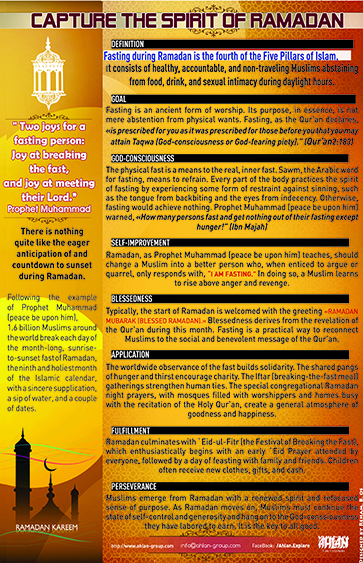
Pilgrimage remains a unique ِgathering where Muslims from diverse cultures worldwide meet, often for the first time. During the time of the Prophet Muhammad (peace be upon him), most people from Medina had not traveled widely, so encountering Muslims from Africa, Yemen, and the Levant allowed them to witness the early expressions of Islam firsthand.
This article covers why it is known as the farewell pilgrimage, its meaning, and its value to the muslim community. Then we will go deeper to learn more about the new principles that were mentioned in the farewell sermon hadith.
Farewell Pilgrimage Meaning
The Prophet’s Pilgrimage was historically significant because many who became his companions (Sahaba) met him during this pilgrimage. The Prophet stayed in Medina for nine years before announcing his intention to perform Hajj in the tenth year. This announcement generated excitement, and tens of thousands gathered around Medina, eager to join him on this journey, making it the largest assembly of Sahaba, around 144,000 people.
Read more:
Why is it called Farewell Pilgrimage?
The Prophet’s first pilgrimage was known as the Farewell pilgrimage because the Prophet indicated it might be his last and it was the only time he performed it.
The Prophet performed Pilgrimage as a combined Umrah and Pilgrimage (Ifrad). He advised others to separate Umrah and Hajj (Tamarat), noting that if he repeated Hajj, he would choose this method.
Learn more about Types of Hajj in Islam:
Types of Hajj in Islam: Hajj Ifrad, Hajj Qiran, and Hajj tamattu Explained!
The Setting of the Farewell Pilgrimage
The Prophet (peace be upon him) delivered this sermon in Makkah—the very city that, about 20 years earlier, had prevented him from praying. At that time, he was alone, then accompanied by only a few Muslims who were harmed, fought, persecuted, and forced to emigrate to Abyssinia to worship Allah.
Then, by Allah’s promise and victory for His servant, the days turned. The Prophet (peace be upon him) stood in that same city—now accompanied by tens of thousands who followed his opinion in every action: how to throw the pebbles, how to circumambulate the House, how to sacrifice, how to worship, how to pray, how to perform pilgrimage rites. They all followed his example in a position where Allah elevated Islam.
Remarkably, this honor and victory were foretold by the Prophet (peace be upon him) when circumstances were unfavorable—during times of weakness and hardship. He encouraged his companions with victory, telling the polytheists: “Wait and see.”
The sermon was concise but packed with profound guidance about righteousness, justice, social order, economic fairness, and the respectful treatment of women. It is a timeless message urging Muslims to study, reflect, and implement these teachings for a just and prosperous society.
Learn more about the Pilgrimage Rituals: Hajj Rituals – How to Perform Hajj in 10 Steps!
Farewell Sermon Hadith
The farewell sermon, if fully implemented by Muslims, could lead the world once again as it did during the golden era of Islam when Muslims followed his teachings exactly. Let’s analyze each part of the hadith in more depth.
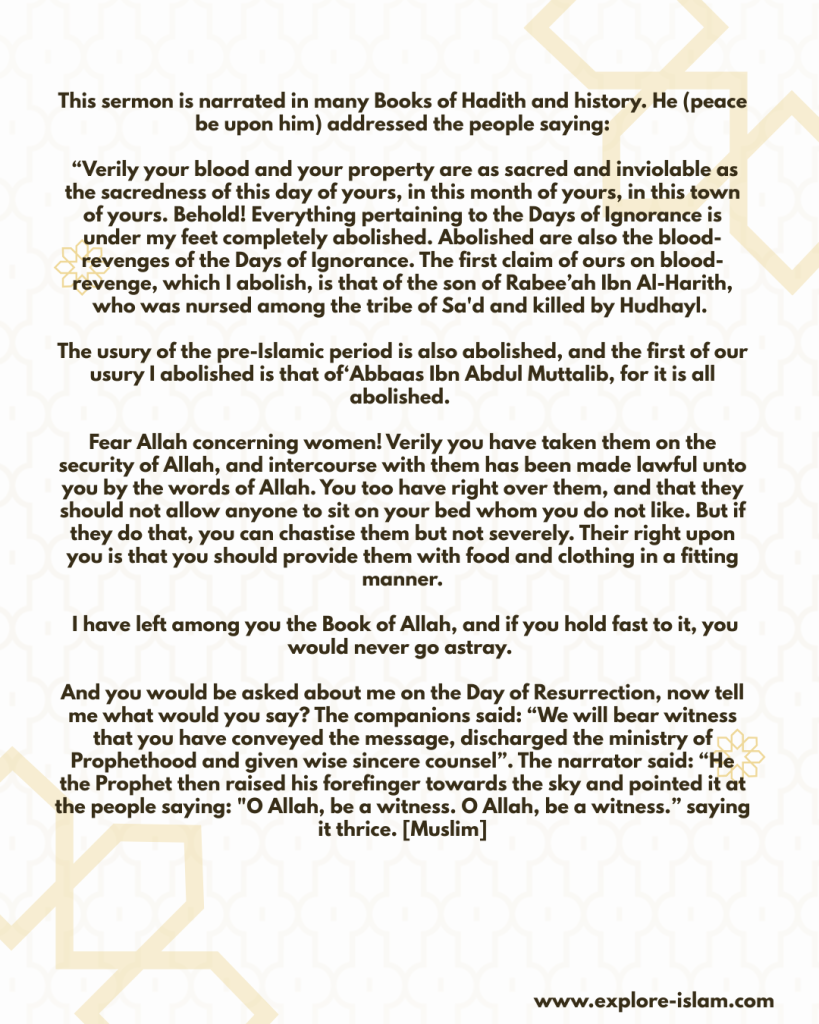
Sanctity of Blood and Wealth has top priority in Farewell Pilgrimage
The Prophet began by declaring that people’s blood and wealth are sacred and inviolable, comparable to the sanctity of the Day of Arafah, the sacred month of Dhul-Hijjah, and the holy places. He emphasized that harming others, taking their wealth, or tarnishing their reputation is forbidden.
This re-established fundamental rights between people, especially given the diverse tribes present, who had a history of tribal conflicts, raids, and honor-based violence.
The Prophet then abolished pre-Islamic customs that contradict Islamic teachings. He specifically ended blood feuds, where tribes would kill innocent members in retaliation. He declared all such practices canceled, emphasizing individual responsibility: no one bears the burden of another’s sins.
“The first blood I abolish is the blood of Ibn Rabi’ah ibn Al-Harith,” a cousin’s son of the Prophet, who was nursing among Banu Sa’d and was killed by Hudhayl while crawling between the houses. The Prophet begins with his own relative in abolishing Jahiliyyah blood feuds—not because it is easy for him and hard for others, but so no one can claim favoritism. This is leadership: the leader must be the role model, starting with himself when abolishing privileges or rights tied to close relatives.
He further condemned riba (usury/interest), labeling it a major sin. He warned of the severe curse on those who give, take, write contracts, or witness riba transactions. Reflecting on the modern world, he anticipated the oppressive nature of compound interest that enslaves nations and individuals financially. Again, Starting With His Uncle, “The first interest I abolish is our interest—the interest of Al-Abbas ibn Abd Al-Muttalib,” the Prophet’s uncle. He announced this publicly and unhesitatingly, showing that Islam tolerates no favoritism.
The Prophet publicly declared that all previous eras, glories, long histories of their fathers and grandfathers, are called “Jahiliyyah.”
“Jahiliyyah” now defines that entire period with its laws and customs. Islam replaces it. The previous era is “Jahiliyyah”; the new era is “Islam.” Was there good in Jahiliyyah? Yes. There were noble morals, courage, generosity, and chastity.
But these existed within a dominant Jahili system. When judging periods not founded on Islam, the overall system defines them. So it is correct to call this period “Jahiliyyah” even if there were scattered good aspects.
Allah says:
“Do they seek the judgment of Jahiliyyah? And who is better than Allah in judgment for a people who are certain [in faith]?”
Good Treatment of Women is highlighted in the Farewell Pilgrimage
Prophet Muhammad PBUH said in the farewell pilgrimage, reminding his followers of women’s rights:
“Fear Allah concerning women! Verily you have taken them on the security of Allah, and intercourse with them has been made lawful unto you by the words of Allah. You too have right over them”
Islam is the ONLY religion giving women complete justice. Equality with men is not natural for women; Islam gives them full rights appropriately.
“Word of Allah” refers to either the Quranic permission to marry lawful women or the marriage contract (offer and acceptance) recognized by Allah. The relationship is under Allah’s permission.
The Prophet urged Muslims to fear Allah regarding the treatment of women. He highlighted that women were previously disregarded and dishonored, but Islam uplifted their status, securing their financial rights and freedom of choice. However, women remain naturally different from men, created to be submissive and under male guardianship. Men are commanded to honor, provide for, and protect women, forbidding any form of physical or emotional abuse.
Holding Fast to the Quran is part of the Farewell Prophetic advice
In his final sermon to Muslims in pilgrimage, Prophet Muhammad stresses the necessity of taking the Quran seriously:
“I have left among you the Book of Allah, and if you hold fast to it, you would never go astray.”
The Quran is the eternal miracle, protected from falsehood “from before it and behind it.” Those who read, learn, ponder, act upon, teach, and memorize it attain great reward. Sadly, many Muslims neglect reading, pondering, and spreading it.
This is a vital, comprehensive, protective legacy. For the Prophet, delivering this was crucial. “Holding fast” is not merely reciting, memorizing, or reading. It means:
- Acting on what is lawful and unlawful
- Taking lessons and warnings
- Seeking hope in its news
- Living within its orbit
- Making it the reference and foundation for standards
- Returning to it in disputes
- Letting it govern your life, family, and environment
Read also: Is the kaaba an idol?
Conclusion
To conclude, just because the farewell pilgrimage was the last pilgrimage that the Prophet performed, it doesn’t mean that Islam ended here; in contrast, it showed how Islam has grown strong and spread among nations and tribes that used to fight the Prophet Muhammad PBUH and Islam.
The farewell sermon (hadith) has set a firm ground confirming and stressing the most important teachings that, by it, the welfare of the muslim community would be at its best.
If you want to explore more similar topics, join our newsletter or chat with us!