
Have you ever wondered about the history of the Quran or how the Quran we read today was compiled? Was it written during the Prophet Muhammad’s lifetime? How has it been preserved since the Prophet’s life?
In this article, we’ll explore the fascinating history of the Quran from its first revelation to its final compilation, and uncover how it has been perfectly preserved for over 1,400 years. Hence, we will examine the three phases of writing and compiling the Quran, spanning from the prophetic era to the final record, with a focus on the exceptional effort made by the Prophet Muhammad ﷺ and his companions to preserve the Quran.
Summary
The history of the Quran begins with its revelation to Prophet Muhammad ﷺ and continues through its writing, compilation, and preservation. The Quran was revealed over 23 years, recorded by the Scribes of the Revelation, compiled into one manuscript under Caliph Abu Bakr, and standardized during Caliph Uthman’s rule. This article explains each stage and how the Quran has remained preserved for more than 1,400 years.
The first phase in the History of the Quran starts in Prophet Muhammad’s life
One of the earliest and most important stages in the history of the Quran was its preservation during the lifetime of Prophet Muhammad ﷺ. From the moment revelation began, Allah ensured that the Quran was preserved mainly through memorization and assisted by writing. This dual method became the foundation for the Quran’s accurate transmission across generations.
The Divine Revelation to Prophet Muhammad PBUH is the starting point of Quran on Earth
The Prophet Muhammad ﷺ routinely sought spiritual seclusion in the Cave of Hira. It was during one of these retreats that the angel Gabriel suddenly appeared. Gabriel issued the profound command, “Read!” three times, each time met by the Prophet’s honest reply that he was illiterate. Following this pivotal exchange, Gabriel commenced the initial verses of the Quran’s revelation.
“Read, ‘O Prophet’, in the name of your Lord who created.”
Since then, the verses of the Quran had been revealed over a period of 23 years, until the death of the Prophet Muhammad. It was not revealed all at once, but rather it was revealed to the Prophet ﷺ in parts, according to specific events and incidents, to strengthen the Prophet’s heart, to facilitate memorization, and to make the obligations more applicable and easier to follow.
Read more:
The Prophet Muhammad’s ﷺ Commitment to Preserving the Quran
Although Prophet Muhammad ﷺ was unlettered (unable to read or write), he took great care to ensure that every revealed verse was accurately preserved. The Quran itself confirms this:
“And you did not recite before it any scripture, nor did you write one with your right hand. Otherwise, the falsifiers would have doubted.”
The Prophet’s inability to read or write was not a deficiency. Rather, it was one of the clear signs of his prophethood. Had he been literate before revelation, critics could have claimed that he composed the Quran from previous writings. Instead, the Quran’s unmatched knowledge and eloquence came through revelation from Allah alone.
Since the Prophet ﷺ did not write himself, he instructed trusted companions to record every revealed verse immediately after it was revealed.
How the Prophet’s Companions Preserved the Quran during his life
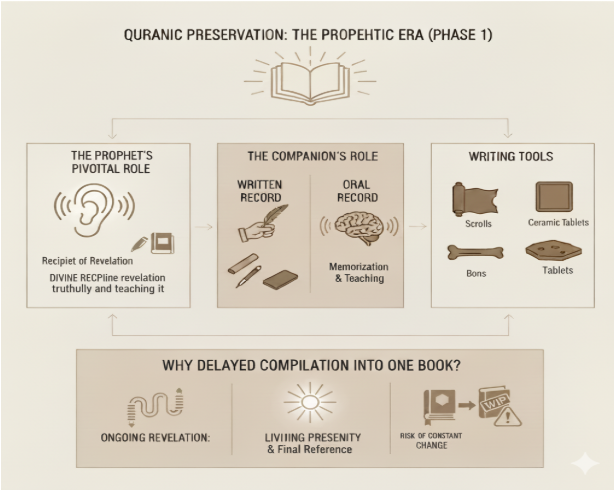
The Companions played a central role in the history of the Quran by preserving it in both written and memorized forms.
Writing Down the Quranic Revelation
Whenever new verses were revealed, the Prophet ﷺ summoned his scribes and instructed them to write the revelation. He also specified the exact chapter (surah) and the precise location where each verse belonged.
After writing, the companions would read the verses back to the Prophet ﷺ, who verified that every word matched the revelation exactly. This careful review ensured complete accuracy from the very beginning.
As a result, the entire Quran existed in written form during the Prophet’s lifetime, even though it had not yet been collected into a single manuscript.
Memorizing the Quran is the main factor of preservation through the Prophet’s companions
Alongside writing, the Prophet ﷺ strongly encouraged his companions to memorize the Quran. They learned the verses directly from him and committed them to memory with great care.
Many companions—both men and women—became skilled memorizers (Huffaz) of the Quran. They later taught the Quran to other Muslims, creating a continuous chain of memorization that has continued throughout Islamic history.
What Materials Were Used to Write the Quran?
During the prophetic era, paper was not widely available in Arabia. Therefore, the companions wrote the Quran on whatever suitable materials they could find, including:
- Animal skins (parchment)
- Shoulder blades and flat bones
- Palm stalks
- Wooden tablets
- Smooth stones
These written records were preserved under the supervision of the Prophet ﷺ alongside the memorization of the Quran by many of his companions.
Why Was the Quran Not Compiled into One Book During the Prophet Muhammad’s ﷺ Lifetime?
Although the Quran was fully written down and memorized during the Prophet Muhammad’s ﷺ lifetime, it was not yet collected into a single manuscript (mushaf). There were two main reasons for this.
There were two main reasons why the Quran was not compiled into a single manuscript during the lifetime of Prophet Muhammad ﷺ.
The Prophet ﷺ Was Present
Since the Prophet ﷺ was alive and personally conveyed the revelation, there was no need to compile the Quran into a single manuscript during his lifetime. He directly taught the Quran to his companions, supervised its writing, and ensured that every revealed verse was preserved accurately.
The Quran Was Revealed Gradually
The Quran was not revealed all at once. Instead, it was revealed gradually over many years in response to specific events, questions, and situations.
If the Quran had been compiled into a single manuscript while revelation was still ongoing, it would have required continuous revisions whenever a new verse or chapter was revealed.
Read more:
Ten valuable tips for non-muslims on how to read the Quran
The Second Stage in the History of the Quran: The First Compilation Under Caliph Abu Bakr
After the death of Prophet Muhammad ﷺ, Abu Bakr (may Allah be pleased with him) became the first Caliph. During his reign, several factors motivated the Companions (may Allah be pleased with them) to compile the Quran into a single manuscript for the first time.
Why Was the Quran Compiled After the Prophet Muhammad’s ﷺ Death?
There were two main reasons for compiling the Quran after the Prophet’s ﷺ death.
The End of Revelation Made the Quran Ready for Compilation
With the passing of Prophet Muhammad ﷺ, divine revelation came to an end. Since no new verses would be revealed, the Quran could now be compiled into a complete manuscript without requiring further additions or changes.
The Battle of Yamamah Prompted the Compilation of the Quran
During the Battle of Yamamah, many Companions were martyred, including a large number of skilled Quran memorizers (Huffaz). This prompted Umar ibn Al-Khattab (may Allah be pleased with him) to recommend compiling the Quran into a single manuscript. Abu Bakr (may Allah be pleased with him) accepted the suggestion, and the Companions agreed.
What Was the Outcome of the First Compilation of the Quran?
This marked the first compilation of the Quran into a single manuscript. After it was was completed, the manuscript was entrusted to Hafsah (may Allah be pleased with her), the daughter of Umar ibn Al-Khattab and one of the wives of Prophet Muhammad ﷺ.
Read more:
The stages of compilation and standardization of the Quran
The Third Stage in the History of the Quran: The Quran During Caliph Uthman’s Rule
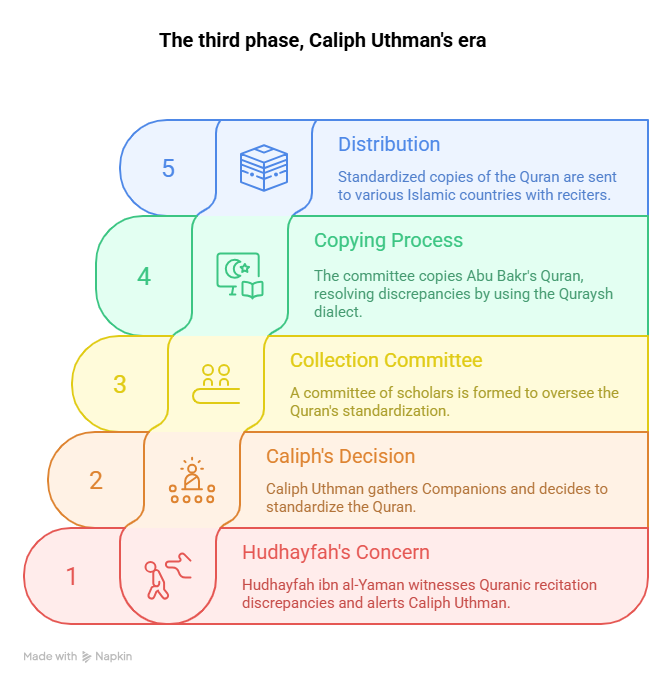
As the Islamic empire expanded around 25 AH, many non-Arab peoples embraced Islam. As a result, differences in the recitation of the Quran began to appear among Muslims in different regions.
The Companion Hudhayfah ibn al-Yaman witnessed this issue and became deeply concerned. He went to Caliph Uthman ibn Affan and said:
“Save the Muslim nation before they fall into the same disastrous splintering as the Jews and Christians.”
How Did Caliph Uthman Preserve the Unity of the Quran?
Caliph Uthman immediately consulted the senior Companions, and they unanimously agreed on one solution: to prepare multiple copies of the Quran and send them to the different Islamic provinces.
Who Was Appointed to Prepare the Quran Copies?
The committee responsible for preparing the copies of the Quran consisted of:
- Zaid ibn Thabit al-Ansari
- Abdullah ibn al-Zubayr
- Saeed ibn al-Aas
- Abdul-Rahman ibn al-Harith ibn Hisham
- Ubayy ibn Ka’b
What Method Was Used to Prepare the Quran Copies?
The committee followed a clear method:
- They copied the manuscript compiled during Caliph Abu Bakr’s reign.
- If there was any disagreement, they wrote the text according to the dialect of the Quraysh.
- They burned all written materials other than these official copies of the Quran.
How Were the Official Copies of the Quran Distributed?
The official copies were sent to the major Islamic regions. Each copy was accompanied by a qualified reciter whose recitation generally matched that of the people in that region, since memorization remained the primary method of preserving and reciting the Quran.
How Did the Companions Respond to Uthman’s Work?
The Companions approved of Uthman’s efforts. Ali (may Allah be pleased with him) said:
“May Allah have mercy on Uthman. If I had been in his position, I would have done what he did with the copies of the Quran.”
Read more:
Why did Caliph Uthman burn the Quran and change it?
How to learn the Quran effectively.
Who Were the Scribes of the Revelation in the History of the Quran?
The Scribes of the Revelation were a select group of Companions chosen by Prophet Muhammad ﷺ to record the verses of the Quran immediately after they were revealed. After the Prophet’s ﷺ death, some of these same Companions were also chosen to compile the Quran during the early caliphates.
What Were the Duties of the Scribes of the Revelation?
The Scribes of the Revelation had two primary responsibilities:
Recording the Quranic Revelation
The scribes wrote down the verses of the Quran immediately after they were revealed. Under the direct guidance of the Prophet Muhammad ﷺ, they placed each verse in its precise position within its respective surah.
Preserving the Quran Accurately
Their primary mission was to document and preserve the Quran with complete accuracy, ensuring that every revealed verse was recorded exactly as it had been revealed.
Who Were the Most Prominent Scribes of the Revelation?
Among the best-known Scribes of the Revelation were:
- Abu Bakr al-Siddiq
- Umar ibn al-Khattab
- Uthman ibn Affan
- Ali ibn Abi Talib
- Zaid ibn Thabit
- Ubayy ibn Ka’b
- Mu’awiyah ibn Abi Sufyan
Why Was Zaid ibn Thabit the Leading Scribe of the Revelation?
Zaid ibn Thabit (may Allah be pleased with him) was one of the most prominent Scribes of the Revelation. During the Prophet’s ﷺ lifetime, he wrote down the Quran under the Prophet’s direct supervision. Later, he was appointed to the committees responsible for compiling the Quran during both the first compilation under Abu Bakr and the preparation of the official copies under Uthman.
He was chosen for this responsibility for several reasons:
- He was a young man, and his qualities made him well suited for this important task.
- He was known for his exceptional intelligence.
- He served as one of the Prophet’s ﷺ scribes and was directly familiar with how the Quran was recorded during the Prophet’s lifetime.
- He was widely recognized for his piety, trustworthiness, excellent character, and integrity.
- He had memorized the entire Quran, and his memorization was based on the Prophet’s ﷺ final review of the Quran.
- He was also respected for his knowledge of other languages, including Hebrew and Persian.
Preservation of the Quran throughout generations is miraculous
The Quran has been preserved for over 1400 years through parallel memorization and writings.
إِنَّا نَحْنُ نَزَّلْنَا ٱلذِّكْرَ وَإِنَّا لَهُۥ لَحَـٰفِظُونَ ٩
“We have, without doubt, sent down the Message; and We will assuredly Guard it (from corruption).”
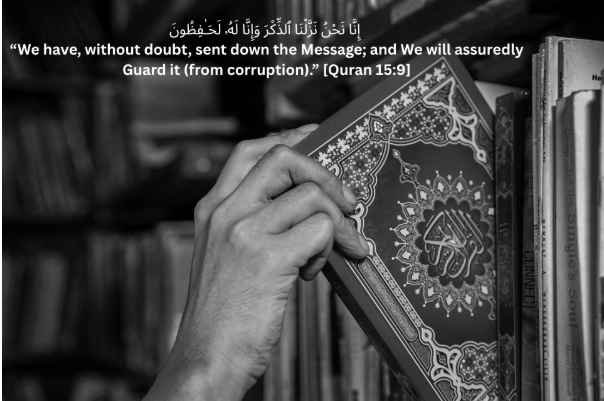
The Quran is currently the only preserved book that has not been subjected to change or distortion, unlike other scriptures. This is because Allah Almighty guaranteed its preservation and assigned individuals to carry out the task of safeguarding it since its revelation.
This preservation journey began with the Prophet Muhammad’s trustworthiness in conveying it, teaching it, and supervising its writing during his lifetime. It continued through the immense efforts of the Companions, who worked tirelessly to transmit the Qur’an to all Muslims exactly as they received it from the Prophet, both orally and in writing. The chain of preservation extends all the way to this day, with millions of Quran memorizers and teachers in existence.
Learn more about the Quran and Islam with Explore Islam
Explore Islam is a non-profit platform providing authentic information about Islam presented in free e-books, updated articles and live chat with a supportive team. Start your journey by reading teh following suggested articles about the Quran:
Are there scientific errors in the Quran?
What do Muslims believe about the Quran?
What is the difference between the Bible and the Quran?
Also, chat with our team to get more answers to your questions about Islam and the Quran.
Conclusion
The journey through the history of the Quran highlights the extraordinary measures taken to preserve the final divine revelation. From its initial oral transmission to its ultimate standardization, the process was guided by both meticulous human effort and divine commitment to its protection.
The comprehensive account detailed in this article underscores several key takeaways regarding the sacred text:
- History of the Quran: The text’s history spans from its first verses revealed to Prophet Muhammad ﷺ in Mecca, continuing over 23 years, to its final standardized form. This timeline demonstrates a continuous process of revelation and immediate recording.
- Preservation of the Quran: The integrity of the Quran was ensured through a dual method: memorization by thousands of companions and simultaneous written recording on various materials. This redundancy protected the text against error or loss.
- How was the Quran written and compiled? Initially recorded on disparate materials like stone, leather, and palm stalks during the Prophet’s lifetime, the Quran was first compiled into a single manuscript (Mushaf) under the Caliph Abu Bakr. Later, under the Caliph Uthman, it was standardized and distributed across the Muslim lands to unify recitations, thus solidifying its canonical form.
- The Scribes of the Revelation: The vital role of the scribes of the Revelation (like Zaid ibn Thabit) cannot be overstated. These trusted companions were responsible for immediately recording the revealed verses, forming the initial written record that served as the foundation for all later compilations and standardizations.
In sum, the history of the Quran is not merely a record of its text, but a testament to the rigorous, multi-faceted process that ensured its perfect preservation and transmission across generations, leaving the Muslim world with an unadulterated source of faith and law.
FAQs
1. What is the history of the Quran?
The history of the Quran begins with its first revelation to Prophet Muhammad ﷺ in the Cave of Hira around 610 CE. The Quran was revealed gradually over 23 years, memorized by the Prophet and his companions, written down by the Scribes of the Revelation, compiled into one manuscript during Caliph Abu Bakr’s rule, and later standardized under Caliph Uthman to preserve its authentic recitation.
2. Who wrote the Quran during the Prophet Muhammad’s ﷺ lifetime?
Prophet Muhammad ﷺ did not write the Quran himself because he was unlettered. Instead, he instructed trusted Companions, known as the Scribes of the Revelation, to write every verse immediately after it was revealed. Among the most prominent scribes were Zaid ibn Thabit, Ubayy ibn Ka’b, Mu’awiyah ibn Abi Sufyan, and Ali ibn Abi Talib (may Allah be pleased with them).
3. Why was the Quran not compiled into one book during the Prophet’s ﷺ lifetime?
The Quran was not compiled into a single manuscript during the Prophet’s ﷺ lifetime because revelation was still ongoing. Since new verses continued to be revealed over 23 years, compiling the Quran into one book before revelation ended would have required continual revisions. The Prophet ﷺ was also personally supervising the preservation of every revealed verse.
4. Who compiled the Quran into one book for the first time?
The first compilation of the Quran into a single manuscript took place during the caliphate of Abu Bakr (may Allah be pleased with him). After the Battle of Yamamah, Umar ibn al-Khattab recommended compiling the Quran because many Quran memorizers had been martyred. Abu Bakr approved the proposal and appointed Zaid ibn Thabit to lead the compilation.
5. Why did Caliph Uthman prepare multiple copies of the Quran?
As Islam spread to different regions, differences in Quran recitation began to appear among new Muslim communities. To preserve the unity of the Quran, Caliph Uthman prepared official copies based on Abu Bakr’s manuscript and distributed them to the major Islamic provinces.
6. Has the Quran changed since it was revealed?
No. Muslims believe the Quran has remained unchanged since its revelation over 1,400 years ago. Its preservation has been ensured through continuous memorization, careful written documentation, and the standardized copies prepared during Caliph Uthman’s reign, fulfilling Allah’s promise to preserve His revelation (Quran 15:9).
7. How was the Quran preserved before paper was widely available?
Before paper became common, the Companions wrote the Quran on materials available in Arabia, including parchment, palm stalks, wooden tablets, shoulder bones, and smooth stones. At the same time, many companions memorized the Quran, providing a second method of preservation.
8. Who was Zaid ibn Thabit, and why was he chosen to compile the Quran?
Zaid ibn Thabit was one of the Prophet Muhammad’s ﷺ principal Scribes of the Revelation. He wrote the Quran under the Prophet’s supervision, had memorized the entire Quran, and was known for his intelligence, trustworthiness, and excellent character. These qualities led Abu Bakr and Uthman to appoint him to lead the Quran’s compilation.
9. How long did the revelation of the Quran take?
The Quran was revealed over approximately 23 years, beginning in Mecca and continuing after the Prophet Muhammad ﷺ migrated to Madinah. The gradual revelation strengthened the Prophet ﷺ, addressed real-life situations, and made the teachings easier for the believers to learn and apply.
10. Why is the history of the Quran important?
The history of the Quran demonstrates the extraordinary care taken to preserve Allah’s final revelation. From its gradual revelation and immediate recording to its compilation and standardization, every stage contributed to safeguarding the Quran’s authenticity and accurate transmission to future generations.