Islam believes in the existence of angels. God Almighty is the Creator of every visible and invisible creature. One of the six pillars of faith (Imaan) in Islam is the belief in the existence of angels. It is one of the fundamentals for every believer. When answering the question about faith.
The angels are messengers of God who carry out His universal and religious command. Let’s examine some authentic evidence that proves Islam believes in angels and their number.
Does Islam Believe in Angels?
Islam believes in Angels. God Almighty created angels, as He is the Creator of everything. Muslims believe in the unseen as described in the Quran and Sunnah. Muslims believe in the existence of angels and the missions they are assigned by God Almighty.
“The Messenger has believed in what has been sent down to him from his Lord, and so do the believers. Everyone (of them) has believed in God, His Angels, His Books, and His Messengers.”
Who Are Angels?
God Almighty created angels before Adam. The following are some characteristics of angels, highlighting their nature in Islamic belief.
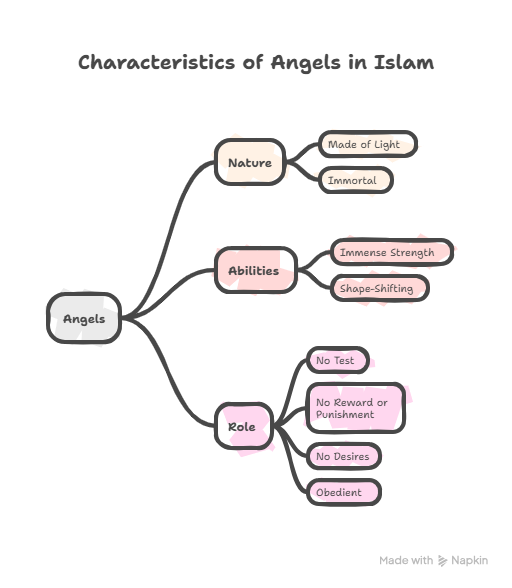
Angels Are Created from Light
Angels are believed to be luminous creations of Allah that were created from light. `Aishah (May Allah be pleased with her) reported: The Messenger of Allah (PBUH) said, “Angels were created from light, jinns were created from a smokeless flame of fire, and ‘Adam was created from that which you have been told (i.e., sounding clay like the clay of pottery).” [Sahih Muslim].
Angels Are Pure Servants of God
Angels are relentlessly obedient to their Lord, creatures without free will; they fear their Lord above them, and they do what they are commanded. God Almighty says:
“[All] praise is [due] to Allah, Creator of the heavens and the earth, [who] made the angels messengers having wings, two or three or four…”
Also, God Almighty says in the Qur’an:
“And to Allah prostrates whatever is in the heavens and whatever is on the earth of creatures, and the angels [as well], and they are not arrogant. They fear their Lord above them, and they do what they are commanded.”
Angels Are Not Gods
Angels are among the creatures of God Almighty. They also are not females and daughters of God, as believed in the previous doctrines.
“Still they have labelled the angels, who are servants of the Most Compassionate, as female. Did they witness their creation? Their statement will be recorded, and they will be questioned!”
Purpose of Angels’ Creation
God Almighty created angels to worship and glorify Him. He Almighty says:
“وَمَا خَلَقْتُ ٱلْجِنَّ وَٱلْإِنسَ إِلَّا لِيَعْبُدُونِ”
“And I did not create the jinn and mankind except to worship Me.”
Angels’ Special Abilities
God Almighty gave the angels more abilities than us. They were divided according to their missions following the Divine Commands. Let’s see their missions in the universe, their connection with mankind, and their role in the Hereafter.
Angels Were Created Before Humans with Human Needs or Characteristics
They were created before man, as were Jinn, which were created from fire. Also, Angels do not eat, drink, get tired or sick, grow old, or procreate, and they are neither male nor female.
Angels Have Wings
Al-Shaibini reported to us: I asked Zirr b. Hubaish about the words of Allah (the Mighty and Great): “So he was (at a distance) of two bows or nearer”
[Qur’an 53:9].
He said: Ibn Mas’ud informed me that, verily, the Messenger of Allah (PBUH) saw Gabriel and he had six hundred wings. [Sahih Muslim]
Angels Differ in Shape and Size According to Their Mission
Each is created in a manner, shape, and size suitable for its mission. Jabir ibn ‘Abd Allah reported the Prophet (May peace be upon him) as saying:
“I have been permitted to tell about one of Allah’s angels who bears the throne that the distance between the lobe of his ear and his shoulder is a journey of seven hundred years.”
[Al-Albani]
Angels Can Take Human Form by Allah’s Permission
Angels can, with Allah’s will and command, take the form of human beings to perform certain tasks as narrated in authentic Sunnah.
Angels Are Bashful and Modest
They are bashful and modest, as it is evident in the Hadith of `Aisha talking to the Messenger of Allah (PBUH):
“Abu Bakr entered and you did not stir and did not observe much care (in arranging your clothes), then Umar entered and you did not stir and did not arrange your clothes, then Uthman entered and you got up and set your clothes right.” So he (PBUH) said:
“Should I not show modesty to one whom even the Angels show modesty?!”
[Sahih Muslim]
Angels Are Offended by Bad Smells
They get offended as do people. The Prophet (PBUH) said:
“He who has eaten onion or garlic or leek should not approach our mosque, because the angels are also offended by the strong smells that offend the children of Adam.”
[Sahih Muslim]
Angels Love the Believers Whom Allah Loves
Angels love whomever their Lord loves and make Du’aa’ for them. Allah’s Messenger (PBUH) said:
“If Allah loves a person, He calls Gabriel, saying, ‘Allah loves so and so, O Gabriel love him.’ So Gabriel would love him and then would make an announcement in the Heavens: ‘Allah has loved so-and-so therefore you should love him also.’ So all the dwellers of the Heavens would love him, and then he is granted the pleasure of the people on the earth.”
[Al-Bukhari]
Angels Curse Those Who Disbelieve
Angels curse whomever their Lord curses:
“Indeed, those who disbelieve and die while they are disbelievers – upon them will be the curse of Allah and of the angels and the people, all together, abiding eternally therein. The punishment will not be lightened for them, nor will they be reprieved.”
Does Islam Believe in Angel Numbers?
We do not know an exact number for the angels. God only knows that. The ones who are mentioned in the Quran and Sunnah by their names are Jibril, Mikha’il, Israfil, Malik, who is the Guardian that keeps the seven doors of Hell, Zabaniyah (the seventeen guardian Angels of Hell), Munkar and Nakeer (Angels responsible for asking the dead once entered the grave), Mu’aqibat (Angels for protection), and Haroot and Maroot (2:102).
There are also the eighty mighty angels who carry the Throne, Angels who transport good and bad souls to their last destination, the Angel of Death, the recorders of deeds, and the angels at the gates of Paradise, and the womb angels.
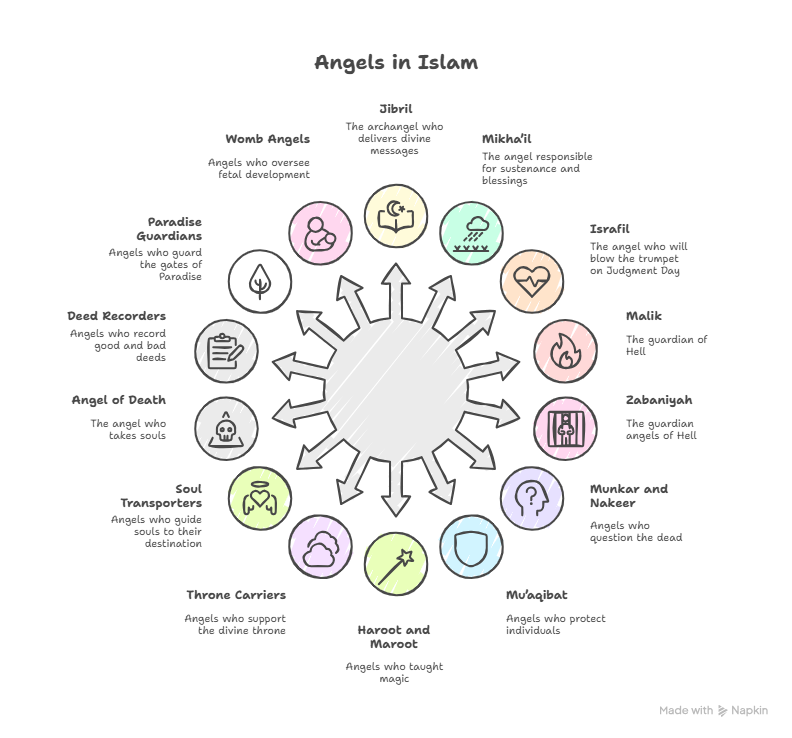
Functions and Names of Some Angels in Islamic Belief
Angels who are assigned for God’s universal Commands are many. They are assigned to put His Commands into action. They send messages, winds, rain, thunder, and some of them are soldiers of God to support the believers and put fear in the hearts of the disbelievers.
Let’s learn about some functions of angels in Islamic belief, including their role in the creation of a baby inside the mother’s womb, angelic protection, recording deeds, delivering Revelation, and their duties in the Hereafter.
Angels Responsible for the Creation of a Baby Inside the Mother’s Womb
The Prophet Muhammad (ﷺ) explained to us the mission of angels during the creation of a baby inside the womb of his mother. He (ﷺ) said:
“When forty-two nights are passed, Allah sends an angel to the nutfah (embryo) and he gives it shape, forming its hearing and sight, its skin, flesh and bones. Then he says: ‘O Lord, male or female?’ Then your Lord decrees whatever He wills and the angel writes it down.”
[Muslim]
Angels Assigned for Protecting Human Beings (Mu’aqibat)
Mu’aqibat are keeper Angels that protect each person from harm and Jinn except when it is decreed; then they let that decree take place. Everyone has an angel appointed to protect them when they are asleep and when they are awake. God Almighty says:
“For him [i.e. each one] are successive [angels] before and behind him who protect him by the decree of Allah…”
The Two Recording Angels (Al-Katiboon)
There are two Angels that accompany each person; one on the right side writing good deeds and the other on the left side writing bad deeds. They both write down all deeds, sayings, and even thoughts, and will be witnesses over each person on Judgment Day.
Jibril: The Angel Responsible for Delivering Revelation
Jibril is named in the Qur’an in three places and mentioned by descriptions in multiple others as the Spirit (Ar-Ruh), a Noble Messenger (Rasulun Kareem), the Trustworthy Soul (Ar-Ruh’ul Ameen), the Holy Spirit (Ar-Ruh’ul Qudus), and in Hadith as The Law (An-Namus).
His major function is to deliver revelation to all Messengers of Allah, and he accompanied Prophet Muhammad (PBUH) on the night of Israa’ and Mi’raj (Night Journey and Ascension).
- Jibril Conveying the Divine Revelation: Jibril was entrusted with bringing the Revelation (the Quran) from God to Prophet Muhammad (ﷺ).
- Angel Jibril’s Physical Description in Islamic Belief: It was narrated in Sahih Muslim that the Prophet Muhammad (ﷺ) saw Jibril in his true form, and he had six hundred wings.
- Jibril Teaching the Quran to Prophet Muhammad (ﷺ): Jibril used to come to the Prophet Muhammad (ﷺ) every night during Ramadan to teach him the Noble Quran.
- Jibril Teaching the Prophet How to Pray: He also led the Messenger in prayer, so that the Prophet (ﷺ) could learn how to properly perform the prayers.
Angel of Death (Malak al-Mawt) and Taking Souls
This angel is entrusted with taking the soul of every human whose time of death has come. He is supported by a group of assisting Angels that carry souls to Heaven or Hell.
Israfil: The Angel Responsible for Blowing the Trumpet
Israfil (Nafikh As-Sur), known as the Angel of the Trumpet, will blow the trumpet twice following the command of God:
- The first blow will announce the death of all creatures.
- The second blow will announce the start of the resurrection.
Munkar and Nakeer Questioning People in the Grave
Munkar and Nakeer are two Angels responsible for asking “The Three Questions of the Grave” and treating a deceased accordingly:
- Who is your Lord?
- What is your religion?
- Who was your Prophet?
The soul is then taken to view its place either in Heaven or Hell, then put back in the grave with a taste of it, either bliss or torment, waiting for resurrection on Judgment Day.
Angels Guarding Hell in Islamic Belief
The Noble Quran mentions angels who serve as guardians and keepers of Hell.
Malik: The Guardian of Hell
Malik is the Guardian that keeps the seven doors of Hell. He is the commander over the seventeen guardian Angels of Hell called “Zabaniyah” with the Will and Power of Allah.
Zabaniyah: The Powerful Angels of Hell
Zabaniyah are the seventeen guardian Angels of Hell. They are described in the Quran as fierce and powerful angels who never disobey Allah in anything He commands them.
“O you who have attained faith, shield yourselves and your families from a fire whose fuel is people and stones; over it are fierce and powerful angels who never disobey Allah in anything He commands them, and they carry out whatever they are commanded.”
Angels Guarding the Gates of Paradise
These angels act as the keepers of Paradise. When the mindful believers arrive at the open gates, the keepers will greet them, saying:
“Peace be upon you! You have done well, so come in, to stay forever.”
Conclusion
God Almighty created the angels. Believing in the existence of angels is among the six pillars of faith in Islam. Can anyone believe in ghosts or aliens without any clear evidence?! Following the Quran and Sunnah, we can learn more about the realm of angels and how they were sent to us as protection, provision and guidance.
To learn more about angels and other Islamic beliefs, start a deeper discussion with our team right now!